- Taro is a traditional food of Vanuatu, and its culture over millennia has resulted in several hundred indigenous varieties. But cassava is more commonly grown nowadays, even as communities rely increasingly heavily upon imported food.
- A key reason that communities are now fighting to reinvigorate taro cultivation is because it’s more resilient to climate shocks: In recent years, severe storms have led to the tiny nation’s islands being cut off from food shipments, but those with healthy taro crops were able to feed themselves and others.
- “To the extent that ancient farming techniques continue to provide resilience in the face of a changing climate, it may also be a taste of the future,” an author who visited Vanuatu last year argues.
- This post is an analysis. The views expressed are those of the author, not necessarily of Mongabay.
The packed-earth trail winds through the dense and tangled forest of Vanuatu, the ocean crashing just meters to our right. Richard Rojo’s feet don’t mind the stones and stumps, and he carries a bush knife and a repurposed rice sack.
It’s a path well-trodden for Rojo, who’s lived here in the village of Tasmate on Vanuatu’s remote west coast of Espiritu Santo Island as a subsistence farmer and fisher all his 40-ish years. I walk-jog to keep up with him as he talks to me over his shoulder, idly whacking at an occasional vine with his knife. We’ve been traveling together a few days now in his open boat up and down this coast, on a reporting trip with the Sunset Santo Environmental Network (SSEN) team so I can see for myself the way villages here are threatened by climate change.
We walk for about 10 minutes as I pepper Rojo with questions. We pass towering trees covered with epiphytic plants and wade across a river before popping out into a clearing the size of a few soccer pitches. Coconut palms edge the far side and, in front of us, earthen berms enclose a shallow rectangular pool maybe 5 by 50 meters (roughly 16 by 164 feet). Inside are rows and rows of chest-high plants with heart-shaped leaves: Colocasia esculenta, or water taro.
Rojo sets down his knife and bag and wades into the pool. “I will go replace some that are dying like this one,” he says, finding his thick digging stick and twisting it into the mud. He inserts the stem of a new plant in the hole.

This water taro plantation is an example of one of the most enduring and threatened cultivation systems on earth. This pool is only three months old, but if Rojo is right, it will help conserve a threatened cultivar of a crucial dietary staple and support ni-Vanuatu (the Indigenous people of Vanuatu) withstand growing threats from climate change.
The environments of Pacific island countries such as Vanuatu, already inherently unstable due to heavy volcanic activity and frequent earthquakes with associated tsunamis, are increasingly facing extreme weather events such as cyclones, flooding and soil erosion whipped up by climate change. On my way here in March 2025, weather apps flashed warnings of three named cyclones, though the region ultimately escaped major impacts.
It was not so lucky in 2015 when Tropical Cyclone Pam hammered 96% of Vanuatu’s crops and livestock populations, contaminated water sources and disrupted subsistence fisheries: In the aftermath of Pam, more than half the country’s population needed immediate food aid. Cyclone Harold in 2020, and Judy and Kevin in 2023, were similarly devastating. In the 2025 World Risk Report, Vanuatu ranked 44th out of 193 countries for disaster risk from such extreme natural events and negative effects of climate change.
It’s one reason why, in December 2024, Vanuatu led a case representing more than 100 countries at the International Court of Justice (ICJ) to ask the court to rule on two things: whether failure to limit greenhouse gas emissions constitutes an ongoing breach of international law, and if so, what reparations are due to low- and middle-income countries. (The court ruled in favor of Vanuatu’s case in July 2025.) It was in the hundreds of pages of written testimony and statements that I came across in the work of Vincent Lebot, a root and tuber crop breeder and researcher with the French Agricultural Research Centre for International Development in Vanuatu’s capital city Port Vila, and one of the world’s leading experts on taro in the South Pacific.
In his testimony, and later through email and publications he shared with me, Lebot explained that climate-related changes to agriculture in Vanuatu (higher temperatures, increased wind and rainfall, more landslides) are expected to affect the food security of 80% of ni-Vanuatu in the coming years. Threats also come from changing lifestyles. Since the beginning of the 20th century and the rise of a global economy, ni-Vanuatu have increasingly relied on imported foods such as white rice, wheat flour and tinned products, which, while more suited to long-term storage than local crops, are less nutritious and require cash in pocket.

More than half the country’s dietary energy is now purchased, and two-thirds of total crop production has been diverted to cash crops such as kava, cocoa, coffee and vanilla. In Vanuatu’s statement to the ICJ, Lebot affirmed that subsistence agriculture was in decline: In 1980, when Vanuatu won independence from French and English colonial rule, households on average were planting five to eight taro gardens, but 40 years later, that number had fallen to one to two gardens.
In this way, Vanuatu is no different from the rest of the world, which has seen a decline in the number of subsistence farms as agriculture has grown increasingly large-scale and positioned toward export. But Vanuatu is distinct in many ways. It is a country of 83 islands nearly 2,000 kilometers (more than 1,200 miles) from the east coast of Australia and, here on the western coast of Santo, there is no power grid to support refrigeration, no roads and no wharves, not even a formalized mail service.
Access to outside markets happens infrequently and by large vessels; people and freight pass between ship and shore on small boats. Each time we’ve landed Rojo’s boat these past few days, he would first bring it around so the stern faced the beach, then two or three people on board would jump chest-deep into the waves to steady the craft, then we’d all join in to drag the craft on shore. Even in fine weather, it’s wet and sketchy work and often draws a crowd.
All that to say that when a storm or a landslide wipes out a village’s gardens, it could be days or even weeks before outside food becomes available, and villages sometimes go months before they are able to start growing their own food again. Thus, it’s critical for ni-Vanuatu to have local sources of nutritious, reliable food.
Though taro remains a staple food for many in Vanuatu, a side effect of increasing reliance on imported food, Lebot told me, is that many of the several hundred taro varieties in Vanuatu are now disappearing. This is partly because taro is not grown from seed but rather propagated vegetatively by replanting stems and waiting for them to root, much as one might take a cutting from a houseplant. In other words, you need living taro plants to make more taro plants. When people eat and plant less taro, varieties maintained for specific taste and cooking profiles begin to disappear. This leads to genetic erosion of the species, making what remains more susceptible to pests such as beetles and leaf blight, as well as to environmental change.
“In the western world,” Lebot told the court through a written statement, “we had the time to develop our agriculture before we were globalized. [Pacific islanders never] had the time before they were globalized. They were bulldozed overnight … [and] the impact has been huge.”
Which is how a single taro plot on a remote coast of a remote island becomes so important to the protection of a tradition millennia old.

Taro resembles a root (think sweet potato) or tuber (think yam), but in fact it’s a corm — the swollen base of a stem the plant uses for energy and nutrient storage — like a water chestnut. It can be roasted over embers or peeled and boiled. It can also be grated and molded into a large pudding-like cake, topped with coconut milk and baked into laplap (something like a tamale; laplap is Vanuatu’s national dish.) Taro is high in antioxidants and proteins and low in fat; the leaves are also edible and rich in vitamins and minerals. In that way, taro is superior to cassava, which was introduced from South America in 1850 because it can be ready for harvest in as little as six months, compared to taro’s nine months. But cassava also grows taller than taro, and is therefore more susceptible to cyclone winds.
It’s this suitability to Vanuatu’s dynamic environment and the nutritional needs of ni-Vanuatu that make SSEN project manager Joses Togase confident in taro’s importance to regional food security. Togase stands at the taro garden with me wearing a bucket hat and tank top, smart phone in hand, though we’re well beyond any signal.
“If there’s a disaster, a [village] chief may call on people of Tasmate to contribute to feed the population,” Togase says, adding that the practice is fading now in favor of the cash economy. He watched this play out as recently as 2024: During a regional meeting in Tasmate, chiefs of other villages flocked to Rojo asking to buy whatever extra taro he had to sell, as their own supplies had been wiped out in a flood and they were eager to get their hands on the variety that grew here.
Seeing that revealed an opportunity to Togase: SSEN could provide cuttings for the whole coast. The organization supported Rojo in building a new pool, and he started the plants in January. I’m amazed that all this work building berms, diverting water, creating a drainage system, has been done by hand in just a few months.
“Look at this bush,” Togase says, pointing to the dense understory surrounding us, tangled with vines and difficult to walk through. “That’s how this place was. This taro has been grown by our ancestors, all over western Santo. This can be done.”
Having finished our tour at the new plot, Rojo takes us deeper into the forest to show us the seven other pools he maintains for himself and his family. We step gingerly through an intricate system of drainage ditches, and he tells me where to rinse my feet of mud. At the edge of the furthest pool, he grabs a taro plant just below its leaves and with a digging stick in his right hand, stabs holes in the sediment around the stem. He wiggles the whole plant and up comes a corm maybe 10 centimeters (almost 4 inches) in diameter, not quite the size of a loaf of bread, small roots wagging like lengths of yarn.
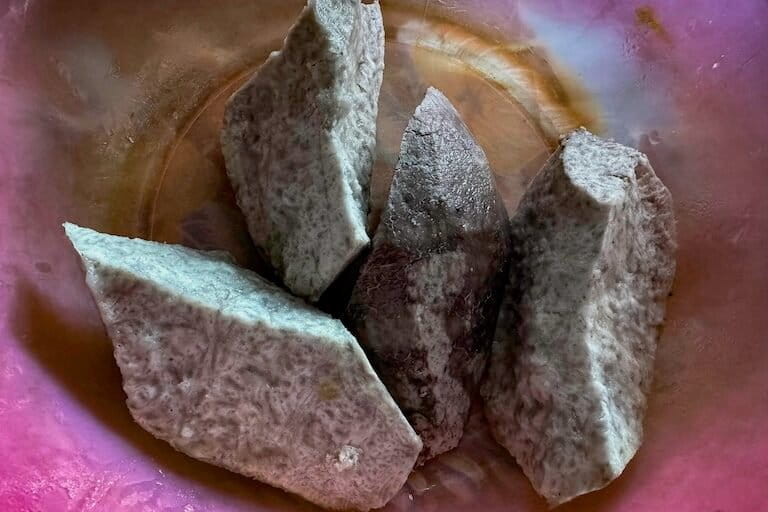
He cuts between the corm and the base of the stem, then lops off the leaves, leaving something that looks like a massive celery heart: These stems, he plants right back in the hole, and the taro cycle begins again. In this way taro production can provide food (and income, when needed) every day of the year. By the end of 2025, Rojo had sold over 40 bundles of this new taro at the market in Luganville, netting about $340.
Food researcher Lebot believes agroforestry plots like these, dispersed over many communities, will help protect taro into the future. The agroforestry system relies on pools fed by the complex hydrology of a rainforest and protected by curtains of trees. In contrast, large plots planted after tree clearing are susceptible to strong winds, droughts and floods. As long as the effects of natural disasters are localized, when one community loses its crop, it should be able to restock from a neighbor. In this way, traditional farming knowledge might be one of the best hopes for keeping ni-Vanuatu healthy and safe as climate change rages around them.
I’d had the chance to eat Tasmate’s taro two nights ago, when we had slept here on our way north along the coast to and from Nambeko. Deeply purple and served boiled as a single large piece on a plate, the flesh was elastic and soft, the texture of fried plantain. The flavor was mildly sweet, somewhere between potato and banana.
Eating it here in the gathering dark of the guesthouse at nightfall, with the sounds of the ocean and forest around us, felt like biting into the past. To the extent that ancient farming techniques continue to provide resilience in the face of a changing climate, it may also be a taste of the future.
Monica Kidd is a multidisciplinary writer and award-winning journalist specializing in science and health reporting. She wishes to thank the Alberta Foundation for the Arts for travel funding and the Santo Sunset Environment Network for logistical support.
Banner image: Food security activist Richard Rojo in his taro garden in Vanuatu. Image courtesy of Monica Kidd.
Related audio from Mongabay’s podcast: A recent advisory opinion from the International Court of Justice on climate change was celebrated by islands for providing certainty on their maritime boundaries regardless of sea level rise, listen to our discussion about that with environmental lawyer Angelique Pouponneau here:
See related coverage:
Philippines hosts new Asia-Pacific hub for sustainable agriculture, cuisine
Small island nations provide big environmental solutions but need finance partners (commentary)
In Philippines, climate change tests Indigenous farming like never before
Citations:
Mehrabi, Z. Likely decline in the number of farms globally by the middle of the century. Nature Sustainability, 6, 949–954 (2023). doi:10.1038/s41893-023-01110-y
Sardos, J., McKey, D., Duval, M. F., Malapa, R., Noyer, J. L., & Lebot, V. (2008). Evolution of cassava (Manihot esculenta Crantz) after recent introduction into a South Pacific island system: The contribution of sex to the diversification of a clonally propagated crop. Genome, 51(11), 912-921. doi:10.1139/g08-080
Credits