V-Mart cuts FY26 revenue growth forecast to 15–18% after weak festive sales
Written by admin on January 24, 2026
Delhi-based V-Mart Retail, which operates a chain of small-sized hypermarkets, has lowered its revenue growth outlook for the fiscal year 2025-26 (FY26) to 15–18% from its earlier estimate of 17–20% after festive-season sales did not meet expectations.
Managing director Anand Agarwal said the company is seeing steady demand but weaker-than-anticipated festive momentum, while margins are expected to continue improving gradually despite the seasonally soft fourth quarter.
Agarwal added that V-Mart Retail plans to expand its store network by about 13–15% annually, with most new stores under the V-Mart brand and the rest under Unlimited, while seeing significant long-term growth potential in India’s organised apparel retail market.
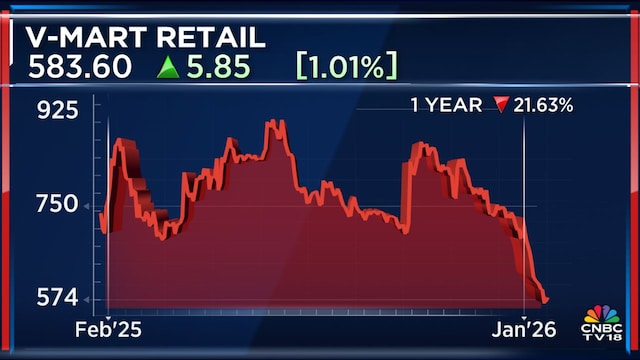
V-Mart’s shares are down over 21% in the past year, and the company has a market capitalisation of about ₹4,635 crore.
These are the edited excerpts of the interview.
Q: What’s your full-year target now and an 2026-27 goal? Why do I ask? Because you said that you expected 20% growth in the festive season. You put quarer two and three together, it’s 15%, right? So, based on this, what does your full-year target stand revised to, and also for next year, if you could give us an early insight?
A: In perspective, we had spoken about around 20% growth that we were targeting for quarter three. For whatever reasons, external or internal, the growth did not come through as planned. But still, the growth aspirations remain very strong. We’re still looking at closing the year at a fairly robust number, growing between 15% and 18% over last year — a tad bit lower than what we had earlier estimated, but still very strong on the overall guidance for the long term.
We are still seeing a lot of good customer sentiment as well as market traction coming in. All the new stores that we are opening, we are getting very good traction there. So, we are very gung-ho on the overall trajectory. A percentage here or there may not matter so much. More important is that we are seeing good, profitable growth. And we’re not, per se, buying growth just to get a headline sales number in.
Q: You said you will end this year with between 15% and 18% revenue growth, right? The first nine months, you’ve done just about 14%, so that puts a lot of onus on the fourth quarter to do that. And by being profitable, what does your exit margin stand at? Because in the first nine months, you’re at 14.5%, which is a near 200-basis-points (bps) improvement.
A: So as of now, it is very difficult to predict the exact margin percentage. But having said that, we have set in motion improvements that are very visible for the first three quarters, so we are hoping that we will be able to continue this momentum even in quarter four.
Also Read | V-Mart Q3 business update: Revenue grows 10% on-year, same-store sales flat
Technically, quarter four is not the best quarter of the year as far as profitability goes. Quarters four and two are always the lean periods, where a major part of the quarter does not generate a lot of profitability. January and February are not very big months. March is a relatively big month. But yes, irrespective of that, we should continue to see some amount of margin improvement — maybe not as high as what we have already delivered in this quarter, but definitely some improvement over last year.
Q: And you’re confident of 15% to 18% despite the fourth quarter being lean and you having done about 14% in the first nine months, right?
A: Yes, I think 16% is the number that we have tracked for the first nine months, but yes, we should be looking at around 15% to 17% for the full year.
Q:
What about the margin mix between V-Mart and Unlimited? Unlimited has reported strong performance this time, where EBITDA for that business has grown over 40%, and margins are at par with your V-Mart business, if not better. Has it been maxed out, or is it likely to show some more outperformance compared to V-Mart?
A: No, I’m still very optimistic about Unlimited. While on a post-Ind AS reported number basis, the Unlimited margins optically look as good as V-Mart, the real number is pre-Ind AS, where the higher rental cost in Unlimited still does not deliver much higher profitability even to date.
But having said that, I’ve been repeating this for a long time — we are very optimistic about Unlimited. That is very virgin territory for us. We have a lot of headroom to grow there. The profitability for all the new stores that we are opening there is fairly good — in fact, much better than even V-Mart stores. So, as we increase our network there, the law of averages will catch up. The newer stores will overshadow the older stores, so we will have much higher profitability as we move forward.
So, we have put in a lot of faith and aspiration behind Unlimited, and we will continue to grow and make this even bigger.
Also Read | Maharashtra will drive our next phase of growth, says Jindal Stainless CEO
Q: Since we are on the subject of store addition, tell us what your plans are for FY27. More importantly, how many will you end FY26 with? How many do you plan on adding in FY27, and if you could share the mix as well between V-Mart and Unlimited?
A: At an overall level, for the long-term trajectory, we should look at around 13% to 15% area growth every year. Now, a base of 500-odd stores last year translates to roughly around 75 stores for FY26, and on that base, roughly around 80–85 stores for FY27.
The ratio between Unlimited and V-Mart will be somewhere around 80:20, so 80% will come in V-Mart territories, and 20% will come in Unlimited territories. Irrespective of that, as management, we are more optimistic about expanding in South India under Unlimited. But as of now, as guidance, what I can say is 80% in V-Mart and 20% in Unlimited.
Q: Just a final question before I let you go. On the larger macro theme, V-Mart has many stores targeting Tier-II, Tier-III and Tier-IV towns and beyond. There are many other retail players too, listed and unlisted, raising money from PE and other investors, and larger players are also looking to access the same market. Is there a risk of saturation? You have shown proof of concept, and now others are entering. So, is growth driven by access, repeat customers, or store additions? How should one look at this space?
A: There are two parts to this answer. One is, when more people come into the same space that you have created and built, it validates the hypothesis that this is something real happening on the ground and that it is sustainable.
The second part is the runway to growth. Even today, not more than 30% of the apparel retail business in India is in the organised segment. Ten years back, this was less than 10%. So, there is still around 70% headroom, where the shift from unorganised to organised needs to happen.
Over and above that, the market itself is growing as gross domestic product (GDP) and consumption grow. So, there is significant headroom for all of us to grow. Who delivers better will depend on who understands the customer, has regional relevance, is disciplined, and is a long-term player.
From a market perspective, it is an attractive space, with validation coming from other players entering, and there is still a lot of headroom for growth.
For the full interview, watch the accompanying video
Catch all the latest updates from the stock market here
Catch the latest Budget 2026 expectations updates here
Catch all the latest updates from the Q3 earnings here