Ubisoft initiates colossal restructure to become a more ‘gamer-centric’ company
Written by admin on January 22, 2026
Chris Kerr, Senior Editor, News, GameDeveloper.com
January 21, 2026
6 Min Read
Ubisoft has announced a sweeping organizational, operational, and portfolio reset that will result in multiple project cancellations, studio closures, the implementation of a return-to-office mandate that will require all teams to work on-site five days a week, and a widespread “rightsizing” that will result in the “acceleration of cost reduction initiatives.”
In a sprawling document shared with investors earlier today, the Assassin’s Creed publisher—fresh off the back of securing a $1.25 billion investment from Tencent, which came amid ongoing (and robust) layoffs—outlined a plan to “reclaim its creative leadership, regain agility and drive a sharp rebound.”
“The new operating model will further empower the execution of the Group’s strategy, centered on Open World Adventures and GaaS-native experiences, supported by targeted investments, deeper specialization, and cutting-edge technology, including accelerated investments behind player-facing Generative AI,” reads the document.
Ubisoft founder and CEO, Yves Guillemot, said the company must pursue a “radically new” value-creation model and become a more “gamer-centric” organization to find its footing in an increasingly competitive and selective triple-A market.
“On the one hand, the AAA industry has become persistently more selective and competitive with rising development costs and greater challenges in creating brands. On the other hand, exceptional AAA games, when successful, have more financial potential than ever. In this context, today we are announcing a major reset built to create the conditions for a return to sustainable growth over time. We are transforming Ubisoft’s operating model to produce exceptional quality games on the two core pillars of our strategy, Open World Adventures and GaaS-native experiences,” explained Guillemot.
Related:Wildgate developer Moonshot Games confirms layoffs
“At the center of this transformation are our Creative Houses, integrated business units now combining production and publishing and therefore unifying the gamer relationship. Each one is built around a clear genre and brand focus, with full responsibility and financial ownership, led by dedicated leadership teams. It is a radical move, relying on a more decentralized creative organization with faster decision making and best-in-class cross functional core services supporting and serving each Creative House.”
“To put the Creative Houses in the best conditions to succeed, we decided to refocus our portfolio with a meaningfully revised 3-year roadmap and accelerate our cost reduction initiatives to rightsize the organization. We will discontinue several projects currently in development and provide additional time to certain games, to ensure enhanced quality and maximize long term value. We will also selectively close several studios and continue restructurings throughout the Group. While these decisions are difficult, they are necessary for us to build a more focused, efficient and sustainable organization over the long term.”
Related:Belfast XR Festival launches 200,000 GBP fund to support emerging XR developers
Guillemot claims the sweeping changes will mark a “decisive turning point” for Ubisoft, leaving it well placed to deliver “sustainable growth” in the years ahead.
A new structure to ‘sharpen strategic focus’ and ‘reinforce execution discipline’
As the graphic below shows, one of the five creative houses Ubisoft has chosen to stake its future on is Vantage Studios, the nascent subsidiary formed with financial backing from Tencent.
Vantage will be focused on scaling and extending Ubisoft’s largest franchises such as Assassin’s Creed, Far Cry, and Rainbow Six.
Four more as-yet-unnamed creative houses will be established to oversee the development of other key franchises, which be sorted based on distinct genres and player experience.
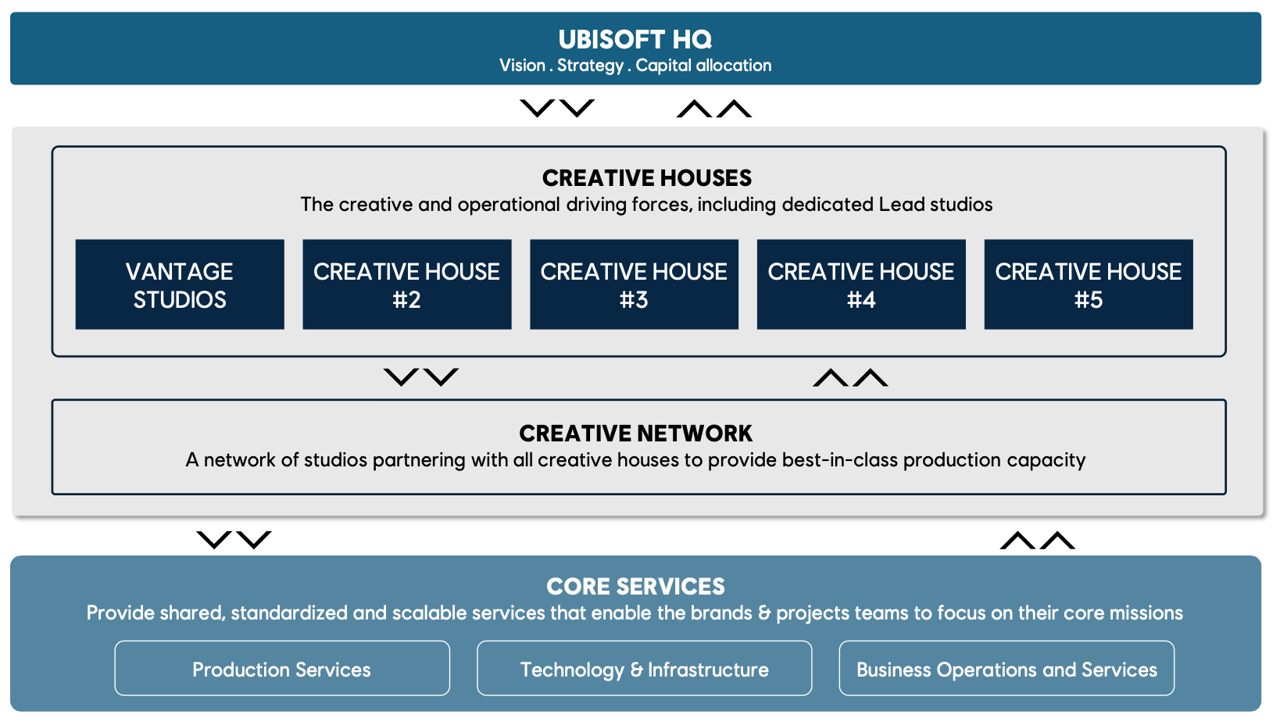
Image via Ubisoft
Notably, Ubisoft said each creative house will be “responsible for fully owning the gamer relationship” and will benefit from dedicated leadership.
Related:Exclusive: 1SP Agency acquires game event networking platform MeetToMatch
“Each Creative House will have end-to-end responsibility for its portfolio, overseeing the full creative and brand scope from development to publishing (brand, marketing and sales go-to-market strategy). They will also be financially accountable, both in terms of P&L and cash generation. This structure will sharpen strategic focus, reinforce execution discipline and ensure that investment decisions will be taken closer to where value is created,” continues the announcement.
“The model also enhances visibility into development pipelines, milestones and key risks, supporting more informed decision-making throughout development cycles.”
Ubisoft explained its franchises will be sorted into each creative house (CH) as follows:
-
CH1 (Vantage Studios), focused on scaling and extending Ubisoft’s largest and established franchises to turn them into annual billionaire brands // Brands including Assassin’s Creed, Far Cry, Rainbow Six
-
CH2 dedicated to competitive and cooperative shooter experiences // Brands including The Division, Ghost Recon, Splinter Cell
-
CH3 designed to operate a roster of select, sharp Live experiences // Brands including For Honor, The Crew, Riders Republic, Brawlhalla, Skull & Bones
-
CH4 dedicated to immersive fantasy worlds and narrative-driven universes // Brands including Anno, Might & Magic, Rayman, Prince of Persia, Beyond Good & Evil
-
CH5 focused on reclaiming position in casual and family-friendly games // Brands including Just Dance, Idle Miner Tycoon
Ubisoft has formed a new organization to support those creative houses while “preserving scale benefits and reducing complexity.” The new business layer will be composed of both ‘Creative Network’ and ‘Core Services.’
According to Ubisoft, Creative Network will unite a “powerful set of studios providing best-in-class production capacity and cross-functional creative expertise serving the Creative Houses.” Notably, it will operate within a structured, project-by-project collaboration framework that allows it to deliver both co-development or end-to-end mandates under the direction of each creative house.
Core Services, meanwhile, has been branded the “backbone” of Ubisoft’s new ecosystem and is described as an “enabler” for its creative houses. It will be responsible for providing scalable technology, production capabilities such as localization and QA, and business operations and services.
To support the implementation of its new model, Ubisoft said it is imperative that employees across all teams return to in-office working five days per week—though it intends to offer an (unspecified) annual allowance of remote working days.
Ubisoft confirms more cost-cutting and possible ‘asset divestitures’
Ubisoft claims all of the above is in service of introducing a refocused portfolio based on a “meaningfully revised roadmap.” What will that cost the company and employees? The answer is ‘a lot.’
The publisher confirmed it has now discontinued six titles that failed to meet its “enhanced” bar for quality. That includes the Prince of Persia: The Sands of Time remake and four unannounced titles (including three new IPs and a mobile game).
When making those cuts, Ubisoft pledged to allocate additional development times to seven other projects to ensure they pass muster.
More layoffs will also seemingly follow those project cancellations, with Ubisoft explaining it must reduce its fixed cost base by an additional €200 million over the next two years in order to realize its grand vision.
“Ubisoft is accelerating its cost reduction initiatives as part of the transformation of its operating model, with the objective of improving structural efficiency, restoring a much higher level of organizational agility and better aligning its cost base with its strategic and creative priorities. This includes rightsizing the organization and focusing resources on core value-creating activities, notably through further restructuring and strict hiring discipline across all functions. The Group also continues to consider potential asset divestitures,” states the announcement.
“As part of this effort to streamline operations and adapt to evolving market conditions, the Group has already taken decisive actions to adjust its studio footprint. This includes the closure of the Halifax mobile studio earlier this month and the Stockholm studio, as well as restructurings at Abu Dhabi, RedLynx and Massive. The current cost reduction program of at least €100 million.”
By the time Ubisoft has concluded the third and purportedly final phase of its restructuring program, the company will have reduced fixed costs by around €500 million since FY2022-23.
About the Author

Senior Editor, News, GameDeveloper.com
Game Developer news editor Chris Kerr is an award-winning reporter with over a decade of experience in the game industry. His byline has appeared in notable print and digital publications including Edge, Stuff, Wireframe, International Business Times, and PocketGamer.biz. Throughout his career, Chris has covered major industry events including GDC, PAX Australia, Gamescom, Paris Games Week, and Develop Brighton.