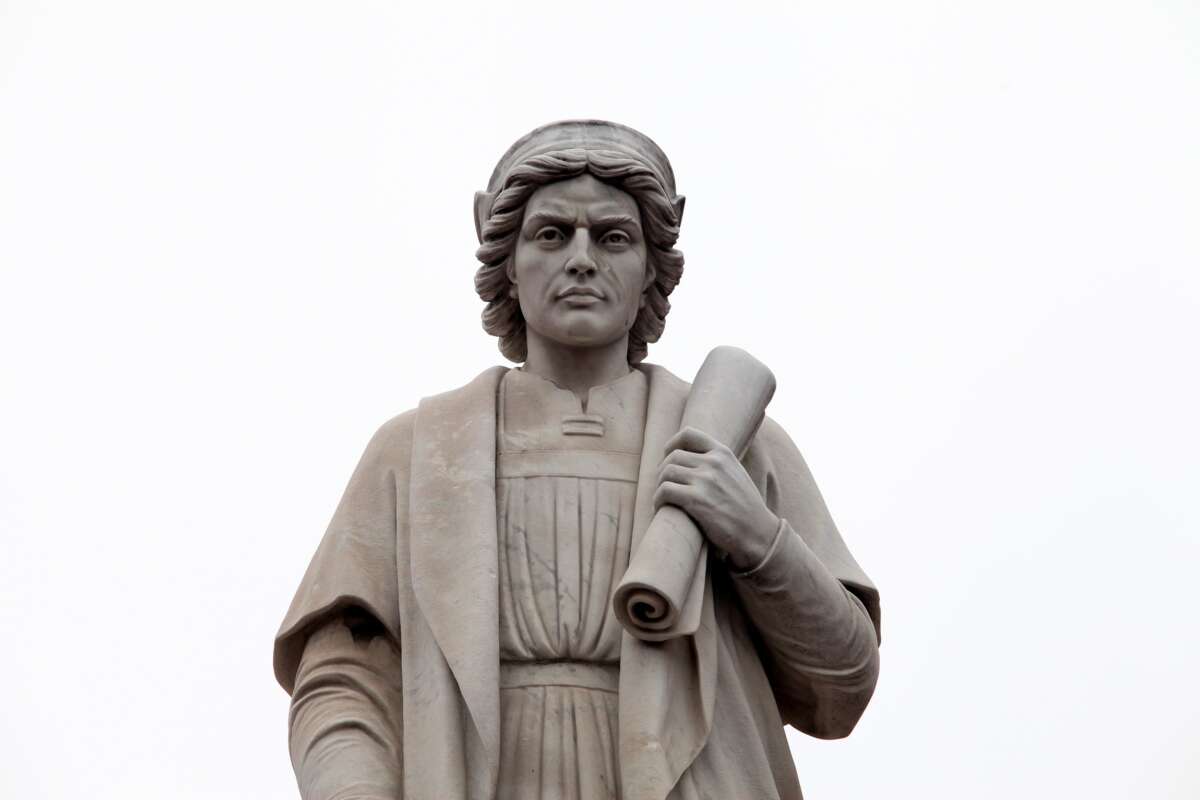
The Trump administration is taking steps toward placing a restored statue of Christopher Columbus — the Italian colonizer whose legacy includes the enslavement and slaughter of millions of Indigenous people in the Western Hemisphere — on White House grounds later this year.
The statue set to be used was formerly damaged and tossed into Baltimore Harbor during the 2020 uprisings against systemic racism in America. John Pica, president of the Italian American Organizations United, said his group recovered the statue and now owns it.
Pica said he was contacted by the White House last fall, around the time of Columbus Day. He also said a loan agreement was signed on Wednesday, with the placement of the statue possibly happening within a matter of weeks.
In response to reports that the statue would be coming to the White House, spokesperson David Ingle told The Associated Press that the move was in line with President Donald Trump’s admiration of Columbus.
“In this White House, Christopher Columbus is a hero. And he will continue to be honored as such by President Trump,” Ingle said.
Reports indicate that the White House will likely put the statue on the South Lawn of the property.
Trump’s obsession with Columbus is well-documented. In April 2025, he wrote in a Truth Social post that he would be “bringing Columbus Day back from the ashes,” despite the date still being an official federal holiday and his predecessor, former President Joe Biden, recognizing the day himself every year while he was in office.
Trump’s Columbus Day proclamation in October was volatile toward those who have called for an end to the holiday. Describing Columbus as “the original American hero,” Trump said he sought to “reclaim his extraordinary legacy of faith, courage, perseverance, and virtue from the left-wing arsonists who have sought to destroy his name and dishonor his memory.”
Trump’s proclamation did not mention the atrocities committed by Columbus, whose arrival in the Americas set into motion a brutal, centuries-long campaign of rape, pillaging, and genocide of Indigenous peoples.
Columbus and his men kidnapped and enslaved thousands of Native people he met while traveling through the Caribbean. In his diaries, he wrote that he believed the people he encountered there would “make fine servants.”
“With 50 men, we could subjugate them and make them do whatever we want,” Columbus wrote in one entry. In addition to those he and his men slaughtered in the Caribbean, hundreds of enslaved people he sent to Spain died on their journey to Europe.
Although slavery was practiced by most European countries at the time, Columbus’s treatment of enslaved people was deemed exceptionally cruel even for the era, with one person involved in his journeys, Bartolomé de las Casas, later condemning Columbus in “A Short Account of the Destruction of the Indies.” The publication provided a horrific account of how Spanish colonizers, under Columbus’s direction, engaged in mass murder against Indigenous people on the islands they arrived on, “slaughtering everyone they found there, including small children, old men, pregnant women, and even women who had just given birth.”
Columbus was later arrested by the Spanish government for administrative misconduct. He was granted freedom by the king of Spain, and given another voyage soon after.
All told, with his mass enslavement of Indigenous people on his many voyages, his direct slaughter of others, and the diseases he and his men brought with them to the Caribbean, it’s estimated that Columbus was responsible for the genocide of hundreds of thousands, if not millions, of Native peoples.
In response to Trump’s Columbus Day declaration last fall, Otoe-Missouria and Choctaw writer Johnnie Jae advocated for the celebration of Indigenous People’s Day instead, laying out the many abuses that Native peoples have endured (and are still battling) in this country.
“Indigenous Peoples’ Day stands in defiance of a nation that has always treated Native sovereignty as an obstacle to overcome in upholding the myth of Manifest Destiny,” Jae wrote in an op-ed for Truthout, adding:
Indigenous Peoples’ Day calls on everyone to honor our survival and acknowledge the ongoing struggle against colonization and genocide. Our struggles are not isolated; they echo in other parts of the world, from the defense of our homelands here to the fight for survival in Gaza, where people continue to resist displacement and violence. It is a reminder that what happens to Native nations today is a glimpse of what can happen to any community when power goes unchecked and rights are violated. Indigenous Peoples’ Day reminds us that defending our sovereignty is defending justice for all.
Media that fights fascism
Truthout is funded almost entirely by readers — that’s why we can speak truth to power and cut against the mainstream narrative. But independent journalists at Truthout face mounting political repression under Trump.
We rely on your support to survive McCarthyist censorship. Please make a tax-deductible one-time or monthly donation.