Markets didn’t just get faster; they got busier. One screen won’t save you anymore. This piece breaks down what a full risk stack looks like on MT4/MT5/cTrader, why time is now your scarcest resource, and how teams turn many small signals into a few right actions—with proof.
If you run a brokerage today, you rarely fight one big fire. You juggle many small ones at once: a quote stream goes a little stale, a copy group wakes up, a swap change is late, margin calls spike after a macro print. None of this is exotic. The problem is time. You don’t get ten minutes to decide; some days you don’t get ten seconds.
The desks that stay calm don’t rely on point tools. They work with a risk stack—a few layers that see, decide, and act together. Fewer tabs. Fewer emails. Fewer “what just happened?” moments.
The job changed: not just faster—busier
-
24/5 meets 24/7. FX still runs five days, but crypto and synthetic products keep risk alive on weekends.
-
Event pile-ups. CPI/NFP and rate decisions now collide with dividends, swaps, and rollovers. Treat them as “edge cases,” and every week becomes an edge case.
-
More automation on the client side. Copy trading and group signals mean flow can switch on instantly, across many accounts.
-
Outage and geo-friction risk. Regional blocks and connectivity incidents don’t wait for quiet hours.
A quick look back (why time is the real risk)
Ten years ago, “one main dashboard + a solid bridge” could carry a retail broker. Today that creates lag debt—little gaps between seeing, deciding, and acting. It seems harmless until a Friday print hits, quotes desync for 90 seconds, and a cohort rides the gap. By Monday you’re doing forensics instead of planning growth.
What a full risk stack actually includes (five layers, plain English)
1. Unified visibility
One place to see the session right now: dealing exposure, A/B books, quotes health, live alerts, across all servers. No swivel-chair ops.
2. Signals that matter
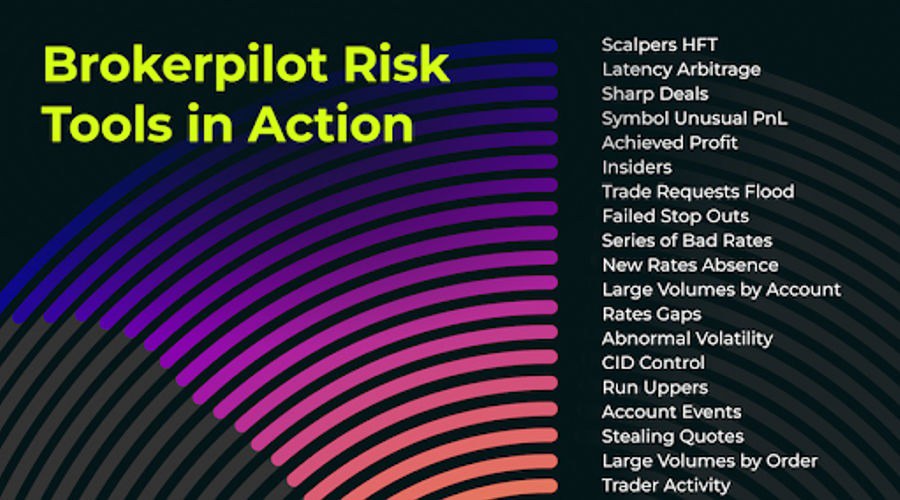
Not vanity charts—actionable triggers. Typical set: Latency Arbitrage, Scalpers/HFT, Copy Cohorts (rings), Insiders, Churning, Rates Gaps/Desync, New Rates Absence, Large Volumes (order/account), Stop-out Abusers, Abnormal Volatility, Symbol-level unusual P&L, and so on.
From our implementations across dozens of brokers, we usually see a few dozen active signals in production at any time; the top five drive most automated actions.
3. Automatic guardrails
Rules tied to signals: route A/B/Hybrid, hedge on accept, tighten leverage by equity tier, quarantine a symbol or group, and run corporate-action jobs (dividends, swaps, rollovers) with prepare → approve → log. Software handles the obvious moves; people look at exceptions.
4. Operations that don’t crack on busy days
A simple calendar so dividends/swaps/rollovers are boring and repeatable—exactly how you want them.
5. Evidence on tap
Clean post-trade reports: quote snapshots, order path (received → last look/accept → fill/reject), which trigger fired, what action ran, and timings. Five minutes to explain an outcome beats five emails.
Bonus: a quotes/ticks store (even feedable to a TradingView widget) helps show what the market looked like at decision time.
What goes wrong without a stack (three familiar stories)
1. The silent desync
Pricing looks fine on screen, but one LP drifts. A small cluster wins on stale quotes. With no automatic hedge, no cohort tag, and no event mode, P&L slips away in minutes; support spends hours explaining slippage.
2. The corporate-action stumble
A swap or dividend update is missed during a chaotic week. Each ticket is small—until there are many. A two-minute calendar job would have avoided the unwind.
3. The “speed is crime” mistake
In fear of toxic flow, you punish all fast traders. Short-term P&L improves; brand and volumes don’t. A better setup separates latency arbitrage from legitimate scalping and treats them differently.
Three drills you can steal this week
1) Macro-print drill (CPI/NFP)
-
−10 min: event mode ON → tighten leverage for low-equity tiers; widen LA thresholds on gold/indices.
-
During: suspected cohorts route conservatively; deep symbols hedge on accept (aim to send the hedge within ~100–150 ms—tune by symbol).
-
+30 min: event mode OFF; thresholds normalize; an after-action report compiles itself.
2) Outage/geo-block drill
Quotes health goes yellow; logins drop from one region. An alert pins it, a comms template goes out, temporary symbol limits apply, and hedge fails over to a backup LP. The report lands in the channel with timestamps and actions.
3) Ops reliability drill
Weekly 15-minute review of dividends/swaps/rollovers: who prepared, who approved, what ran, any diffs. Boring by design. Boring saves reputations.
What to measure (so you know it’s working)
-
Time to detect (TTD): seconds from issue to alert.
-
Time to action (TTA): milliseconds from accept to hedge/route/limit.
-
False-positive rate: how often rules penalize healthy flow.
-
Ops defect rate: missed/incorrect corporate actions per month.
-
Complaint cycle time: minutes to assemble evidence and close a ticket.
If these trends are the right way, P&L and reputation usually follow.
“Isn’t this just more tooling?”
No—fewer decisions at the right moment. A point tool gives you another tab and another alert. A stack removes obvious decisions by encoding them as rules. Dealers get their evening back; risk leads spend Monday on strategy, not archaeology.
A short, anonymized example
A mid-size broker running multiple servers moved from point tools to a stack approach. No buzzwords—just three changes:
1. symbol-specific LA thresholds on XAUUSD and US100,
2. equity-tier leverage around macro prints,
3. a short quarantine for two recurring copy cohorts.
Two weeks later: meaningfully lower exposure to toxic patterns and fewer “why did I get this fill?” threads. Same team. Fewer fires. Results vary; the method is repeatable.
Practical next steps (pick one)
-
Run an event-mode drill this Friday. Tighten leverage for low-equity tiers ten minutes before the print; relax thirty minutes after. Measure TTD/TTA.
-
Make a one-page “signal → action → SLA.” Four rows: Latency Arbitrage, Copy Cohorts, Rates Gaps/Desync, Large Volumes. Agree on who owns each action.
-
Put corporate actions on a calendar. Dividends, swaps, rollovers with prepare → approve → log. Small habit, big risk removed.
Further reading:
Markets didn’t just get faster; they got busier. One screen won’t save you anymore. This piece breaks down what a full risk stack looks like on MT4/MT5/cTrader, why time is now your scarcest resource, and how teams turn many small signals into a few right actions—with proof.
If you run a brokerage today, you rarely fight one big fire. You juggle many small ones at once: a quote stream goes a little stale, a copy group wakes up, a swap change is late, margin calls spike after a macro print. None of this is exotic. The problem is time. You don’t get ten minutes to decide; some days you don’t get ten seconds.
The desks that stay calm don’t rely on point tools. They work with a risk stack—a few layers that see, decide, and act together. Fewer tabs. Fewer emails. Fewer “what just happened?” moments.
The job changed: not just faster—busier
-
24/5 meets 24/7. FX still runs five days, but crypto and synthetic products keep risk alive on weekends.
-
Event pile-ups. CPI/NFP and rate decisions now collide with dividends, swaps, and rollovers. Treat them as “edge cases,” and every week becomes an edge case.
-
More automation on the client side. Copy trading and group signals mean flow can switch on instantly, across many accounts.
-
Outage and geo-friction risk. Regional blocks and connectivity incidents don’t wait for quiet hours.
A quick look back (why time is the real risk)
Ten years ago, “one main dashboard + a solid bridge” could carry a retail broker. Today that creates lag debt—little gaps between seeing, deciding, and acting. It seems harmless until a Friday print hits, quotes desync for 90 seconds, and a cohort rides the gap. By Monday you’re doing forensics instead of planning growth.
What a full risk stack actually includes (five layers, plain English)
1. Unified visibility
One place to see the session right now: dealing exposure, A/B books, quotes health, live alerts, across all servers. No swivel-chair ops.
2. Signals that matter
Not vanity charts—actionable triggers. Typical set: Latency Arbitrage, Scalpers/HFT, Copy Cohorts (rings), Insiders, Churning, Rates Gaps/Desync, New Rates Absence, Large Volumes (order/account), Stop-out Abusers, Abnormal Volatility, Symbol-level unusual P&L, and so on.
From our implementations across dozens of brokers, we usually see a few dozen active signals in production at any time; the top five drive most automated actions.
3. Automatic guardrails
Rules tied to signals: route A/B/Hybrid, hedge on accept, tighten leverage by equity tier, quarantine a symbol or group, and run corporate-action jobs (dividends, swaps, rollovers) with prepare → approve → log. Software handles the obvious moves; people look at exceptions.
4. Operations that don’t crack on busy days
A simple calendar so dividends/swaps/rollovers are boring and repeatable—exactly how you want them.
5. Evidence on tap
Clean post-trade reports: quote snapshots, order path (received → last look/accept → fill/reject), which trigger fired, what action ran, and timings. Five minutes to explain an outcome beats five emails.
Bonus: a quotes/ticks store (even feedable to a TradingView widget) helps show what the market looked like at decision time.
What goes wrong without a stack (three familiar stories)
1. The silent desync
Pricing looks fine on screen, but one LP drifts. A small cluster wins on stale quotes. With no automatic hedge, no cohort tag, and no event mode, P&L slips away in minutes; support spends hours explaining slippage.
2. The corporate-action stumble
A swap or dividend update is missed during a chaotic week. Each ticket is small—until there are many. A two-minute calendar job would have avoided the unwind.
3. The “speed is crime” mistake
In fear of toxic flow, you punish all fast traders. Short-term P&L improves; brand and volumes don’t. A better setup separates latency arbitrage from legitimate scalping and treats them differently.
Three drills you can steal this week
1) Macro-print drill (CPI/NFP)
-
−10 min: event mode ON → tighten leverage for low-equity tiers; widen LA thresholds on gold/indices.
-
During: suspected cohorts route conservatively; deep symbols hedge on accept (aim to send the hedge within ~100–150 ms—tune by symbol).
-
+30 min: event mode OFF; thresholds normalize; an after-action report compiles itself.
2) Outage/geo-block drill
Quotes health goes yellow; logins drop from one region. An alert pins it, a comms template goes out, temporary symbol limits apply, and hedge fails over to a backup LP. The report lands in the channel with timestamps and actions.
3) Ops reliability drill
Weekly 15-minute review of dividends/swaps/rollovers: who prepared, who approved, what ran, any diffs. Boring by design. Boring saves reputations.
What to measure (so you know it’s working)
-
Time to detect (TTD): seconds from issue to alert.
-
Time to action (TTA): milliseconds from accept to hedge/route/limit.
-
False-positive rate: how often rules penalize healthy flow.
-
Ops defect rate: missed/incorrect corporate actions per month.
-
Complaint cycle time: minutes to assemble evidence and close a ticket.
If these trends are the right way, P&L and reputation usually follow.
“Isn’t this just more tooling?”
No—fewer decisions at the right moment. A point tool gives you another tab and another alert. A stack removes obvious decisions by encoding them as rules. Dealers get their evening back; risk leads spend Monday on strategy, not archaeology.
A short, anonymized example
A mid-size broker running multiple servers moved from point tools to a stack approach. No buzzwords—just three changes:
1. symbol-specific LA thresholds on XAUUSD and US100,
2. equity-tier leverage around macro prints,
3. a short quarantine for two recurring copy cohorts.
Two weeks later: meaningfully lower exposure to toxic patterns and fewer “why did I get this fill?” threads. Same team. Fewer fires. Results vary; the method is repeatable.
Practical next steps (pick one)
-
Run an event-mode drill this Friday. Tighten leverage for low-equity tiers ten minutes before the print; relax thirty minutes after. Measure TTD/TTA.
-
Make a one-page “signal → action → SLA.” Four rows: Latency Arbitrage, Copy Cohorts, Rates Gaps/Desync, Large Volumes. Agree on who owns each action.
-
Put corporate actions on a calendar. Dividends, swaps, rollovers with prepare → approve → log. Small habit, big risk removed.
Further reading: