Global carbon dioxide emissions from fossil fuel combustion are projected to reach a record 38.1 billion metric tons in 2025, an increase of 1.1% from 2024, according to the 2025 Global Carbon Budget.
The report, now in its 20th edition, was released Nov. 13 as a preprint. It compiles national energy and emissions data from 21 countries, with contributions from more than 100 researchers. The projections for 2025 are based on preliminary data and modeling.
Researchers predict that emissions rose in several of the world’s largest economies. U.S. emissions were expected to have increased by 1.9%, India’s by 1.4% and China’s by 0.4%. Emissions from international aviation were a standout, with a projected rise of 6.8%.
“With CO2 emissions still increasing, keeping global warming below 1.5°C [2.7°F] is no longer plausible,” Pierre Friedlingstein, a climate scientist at the University of Exeter’s Global Systems Institute who led the study, said in a statement.
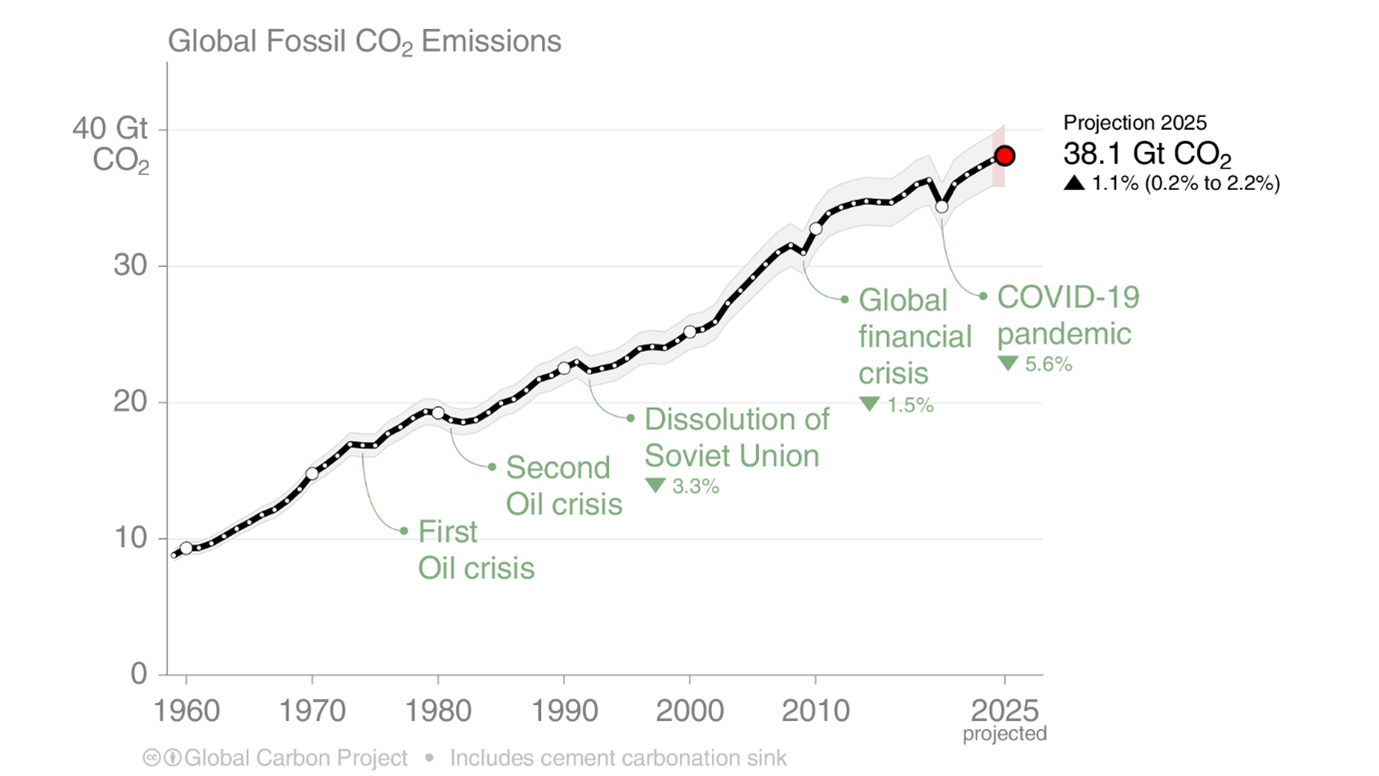
The global atmospheric CO2 concentration increased from 317 parts per million (ppm) in 1960 to a projected 425.7 ppm in 2025. About 8% of this increase is linked to climate change weakening the ability of land and ocean ecosystems to absorb carbon dioxide.
Renewable energy made huge strides in 2025, but not enough to keep pace with the increase in overall emissions, according to data by Ember Energy.
Solar and wind supplied more than 17% of global electricity in 2025, largely thanks to China’s solar power industry, which now provides more than half of the world’s solar panels. African countries are a large and growing market for Chinese solar panels, according to Ember’s end-of-year synthesis.
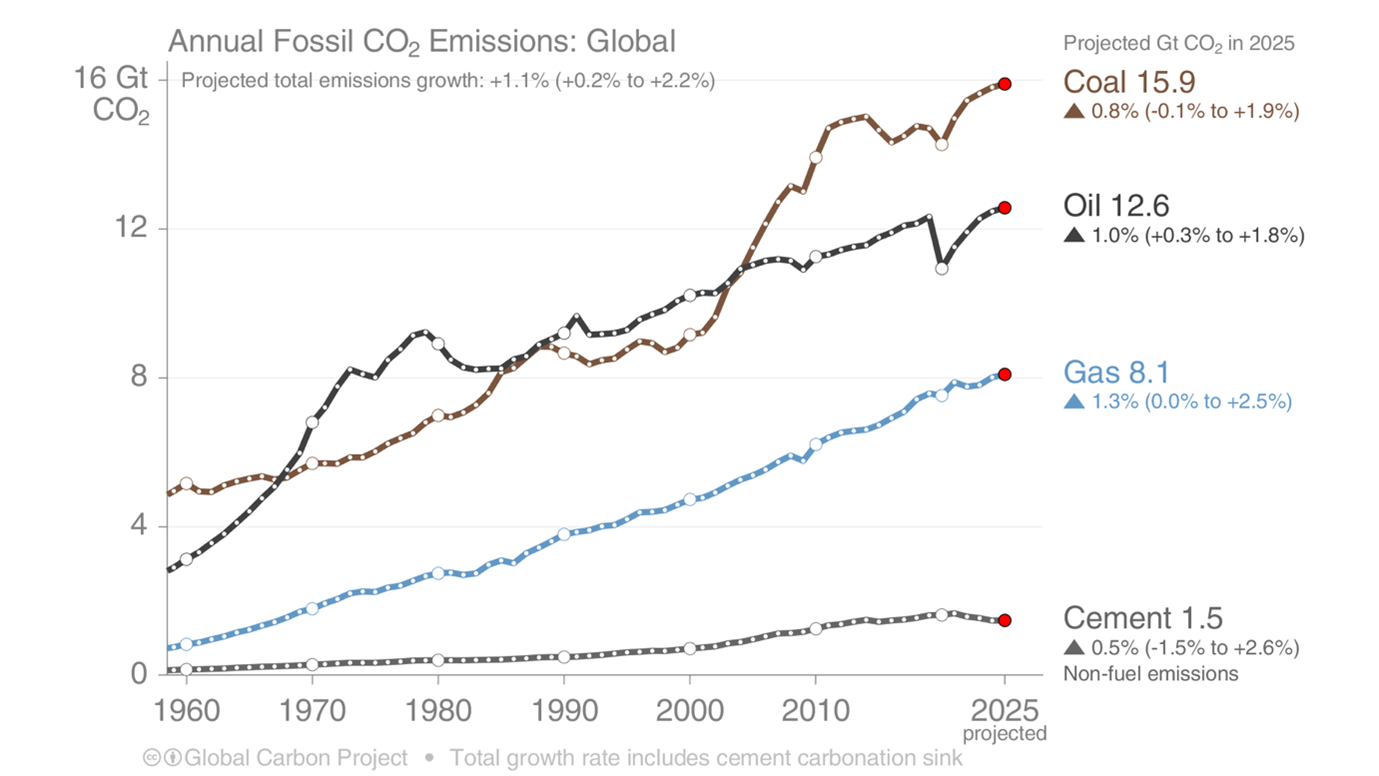
Renewable energy continues to expand rapidly, but not fast enough for a total reduction in fossil fuels. Emissions from burning oil are projected to rise by 1% in 2025, while gas emissions are set to increase by 1.3%, and coal by 0.8%.
Fossil fuel-related financing slowed down in 2022 and 2023. But in 2024, banks embraced fossil fuel projects once again, increasing funding by more than 20% to a total of $162.5 billion, Mongabay’s John Cannon reported.
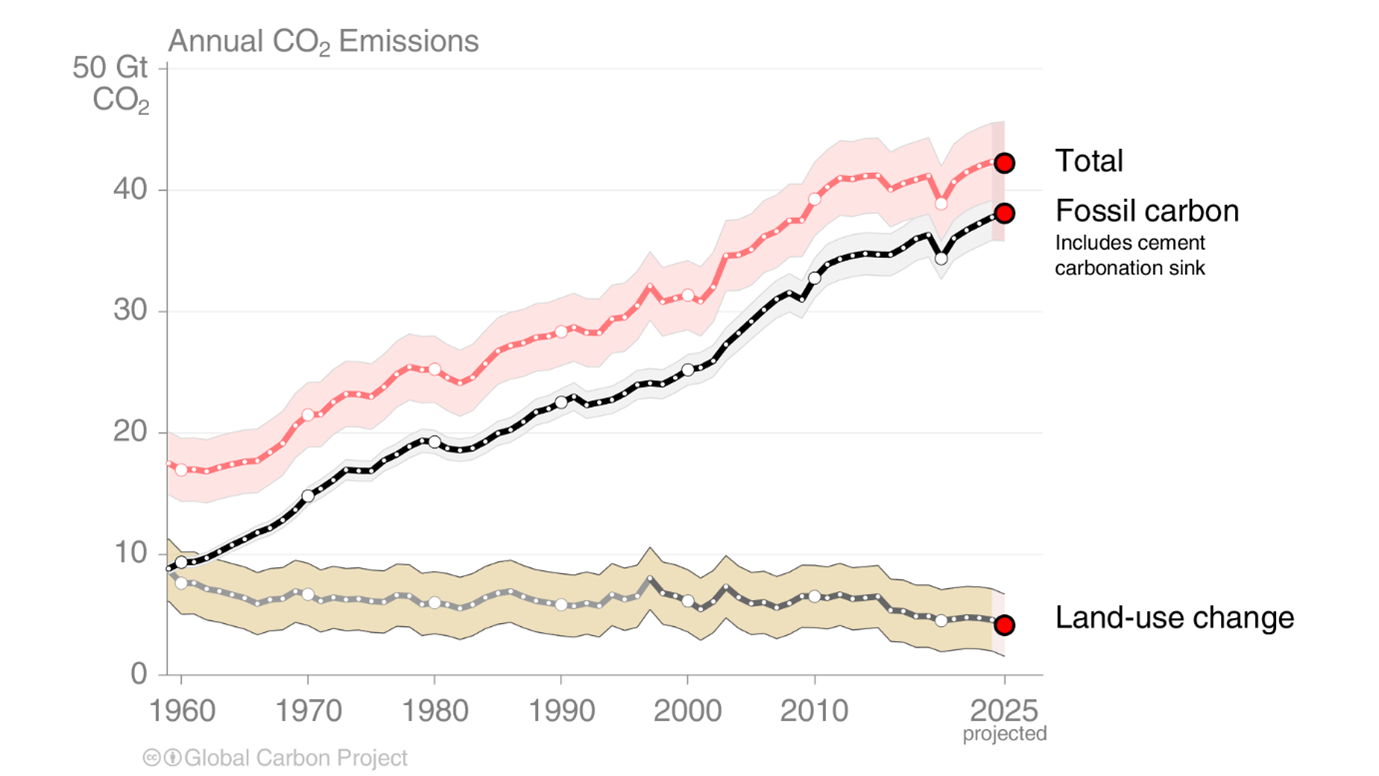
In the decade before the 2015 Paris Agreement, global CO2 emissions were up roughly 18.4%, while in the decade since they’ve increased by 1.2%, according to the U.K.-based Energy & Climate Intelligence Unit (ECIU). Before the Paris agreement, the world was heading for 4°C (7.2°F) of warming above the pre-industrial average by the year 2100; today, the projection is 2.6°C (4.68 °F).
“This shift reflects an extraordinary surge in clean energy deployment, stronger policy frameworks and the mainstreaming of net zero as a common global goal to tackle climate change,” ECIU wrote in its report, published in October. “More progress is still needed, but progress there has been.”
Banner image: An oil refinery in Slovakia. Image by Mariano Mantel via Flickr (CC BY-NC 2.0).
Credits