- The government and private agencies in Bangladesh have rescued at least 351 snakes from various densely populated areas in and around Dhaka city this year. Of the rescued snakes, 319 were venomous.
- A study shows that Bangladesh is home to 89 snake species. Though many of these are non-venomous, a fear of snakebites is widespread among the common people.
- Experts say that excessive and unplanned urbanization is playing a major role in exposing snakes to humans, as the species is losing its habitat due to reduced wetlands and open lands, among other reasons.
On Nov. 1, in a residential area of Bangladesh’s bustling capital city, Dhaka, the NGO Bangladesh Animal Welfare Association rescued two adult Padma Gokhra snakes (monocled cobra, Naja kaouthia) along with seven snakelets and 17 eggs. In October, the NGO had rescued a Khoiya Gokhra snake (spectacled cobra, Naja naja) from a garden in the city’s Uttara residential area.
Meanwhile, according to media reports, the government and private agencies have rescued 351 snakes from various densely populated areas from January to Nov. 1 this year, mostly from Dhaka and its surrounding areas.
Consequently, the city’s residents have expressed worry and anxiety over the news of so many snakes being rescued from residential areas recently.
According to a recent study, 89 snake species are found in Bangladesh. Of them, 30% are venomous.
The study also mentioned that most snakes in Bangladesh are found in forests, wetlands and open areas, including rural homestead gardens, except for an insignificant number that inhabit urban areas.
Experts that Mongabay spoke with said they fear that excessive unplanned urbanization is playing a major role in exposing snakes to humans, as the species is losing its habitat due to reduced waterbodies and the loss of shrubs, among other reasons.

Destruction of habitats
Md Sohel Rana, a herpetologist at Bangladesh Forest Department’s Wildlife Centre, Gazipur, told Mongabay, “Reduced waterbodies, deforestation, industrialization, urbanization and destruction of snake habitats by humans are the reasons for finding snakes in urban homesteads. At the same time, due to the food shortage in the remaining habitats, they also search for food on the ground floor of buildings or in the drainage system.”
Due to the construction of multi-story buildings, converting waterbodies into land, the snake habitat crisis is increasing day by day.
According to a recent study, Dhaka city has lost more than 60% of its waterbodies over 44 years, while its built-up area grew by around seven times, driven by unplanned urban expansion.
Dhaka’s development orientation has systematically violated nature’s right to exist, regenerate and support life, the study argues.
Meanwhile, according to a 2022 study, the city has lost 56% of its green space between 1989 and 2020, and that currently only 2% of the Dhaka city area is covered by vegetation.
“Upon closer inspection, you will see that snake sightings are more common in changing landscape areas. Due to a rapidly changing landscape, most of the wildlife have lost their habitats. As a result, they frequently sneak into human settlements in search of food and shelter,” Rana said.

Impact of declining carnivores
A 2006 study shows that the absence of predators might increase the risk of an insurgence of snakes in an ecosystem.
Mongoose population has also been declining in Bangladesh, observed in both urban and rural areas, due to several human-related factors. Mongooses are considered snakes’ “enemies” due to their ability to attack and kill snakes by neutralizing the venom by producing a glycoprotein.
Monirul H. Khan, a professor of zoology at Dhaka’s Jahangirnagar University, agreed with this view, but not entirely — he said believes that the decline in carnivores is a secondary factor in the increase of snakes in urban areas.
Handling the situation
Although nearly two-thirds of the snake species in Bangladesh are nonvenomous, most of the snakes rescued in Dhaka are venomous ones, leaving the city’s residents concerned. When this is the case, snake-human conflict may increase, experts have warned.
“We should provide shelters for snakes in urban areas, such as by conserving waterbodies and vegetation. It will help keep balance in the ecosystem,” Khan told Mongabay, adding that the government should create some protected areas for the snakes.
Experts said that there is no alternative to increasing people’s awareness to avoid confrontation.
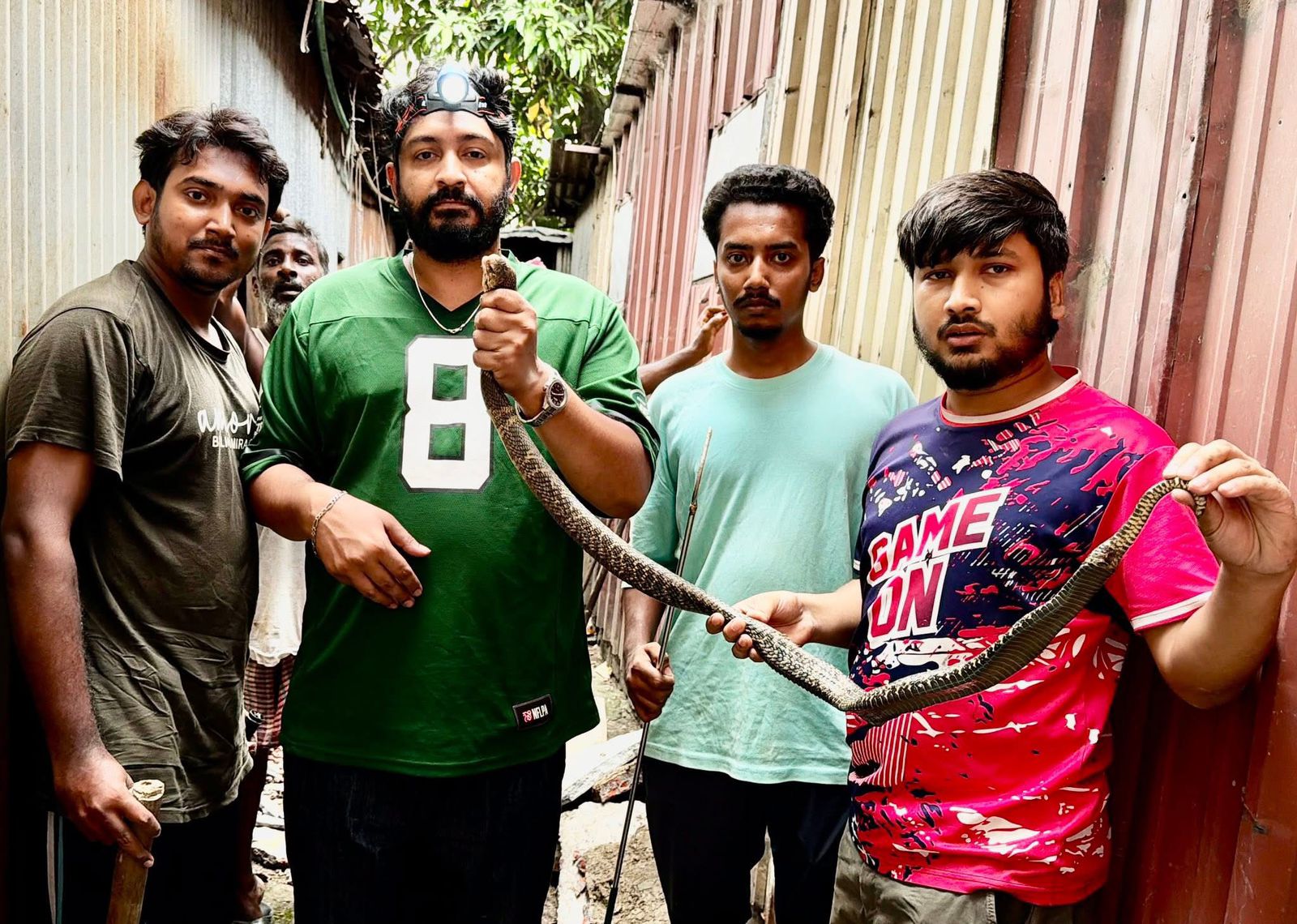
Regarding the sudden increase in the number of snakes in urban areas, Rana said, “However, awareness about snakes has grown now. Earlier, people used to beat snakes to death. News of snake rescues is becoming more common, perhaps due to the widespread use of social media and various volunteer organizations, in addition to the forest department’s rescue work.”
Rana said, “Snakes never attack humans jumping forward unless someone gets too close. Snakes usually scare people by making noise, but this is also a part of self-defense.”
Khan suggested, “To avoid unexpected incidents, people should be careful when moving around areas where snakes are found. This mostly happens in [dark] and shadowy [places], where snakes come out in search of food at night, so one should make noise while walking [after] dusk.”
This is the first time so many snakes have been rescued in a short span of time in Bangladesh, and no scientific research has been conducted on this issue yet.
However, Wildlife Centre, Gazipur, posted an official note regarding the issue, stating that human-made environmental changes, heavy rainfall and rapidly increasing urbanization are responsible for the snake sightings around Dhaka.
The report suggested the enforcement of planned urbanization, wetland conservation and awareness among the people to avoid such urban human-wildlife conflicts.
Banner image: A spectacled cobra in India. Image by Jagadeesh SJ via Flickr (CC BY-NC-SA 2.0).
Black days for black kites in Bangladesh’s growing capital city
Citations:
Haider, I. K. A., Hasan, N., Islam, M. R., Uddin, M. A., Uddin, H., … Chowdhury, M. A. W. (2025). Revisiting the snakes of Bangladesh: a systematic review of species diversity and distribution patterns. Herpetozoa, 38: 253-269. doi:10.3897/herpetozoa.38.e163473
McCauley, D. J., Keesing, F., Young, T. P., Allan, B. F., & Pringle, R. M. (2006). Indirect effects of large herbivores on snakes in an African savanna. Ecological Society of America, 87(10), 2657-2663. doi:10.1890/0012-9658(2006)87[2657:IEOLHO]2.0.CO;2
Nawar, N., Sorker, R., Chowdhury, F. J., & Rahman, M. M. (2021). Present Status and Historical Changes of Urban Green Space in Dhaka City, Bangladesh: A Remote Sensing Driven Approach. Environmental Challenges, 6. doi:10.1016/j.envc.2021.100425
Credits