Feature: Capcom’s Tokyo Art Exhibition Is a Celebration of Gaming Greatness
Written by admin on February 12, 2026
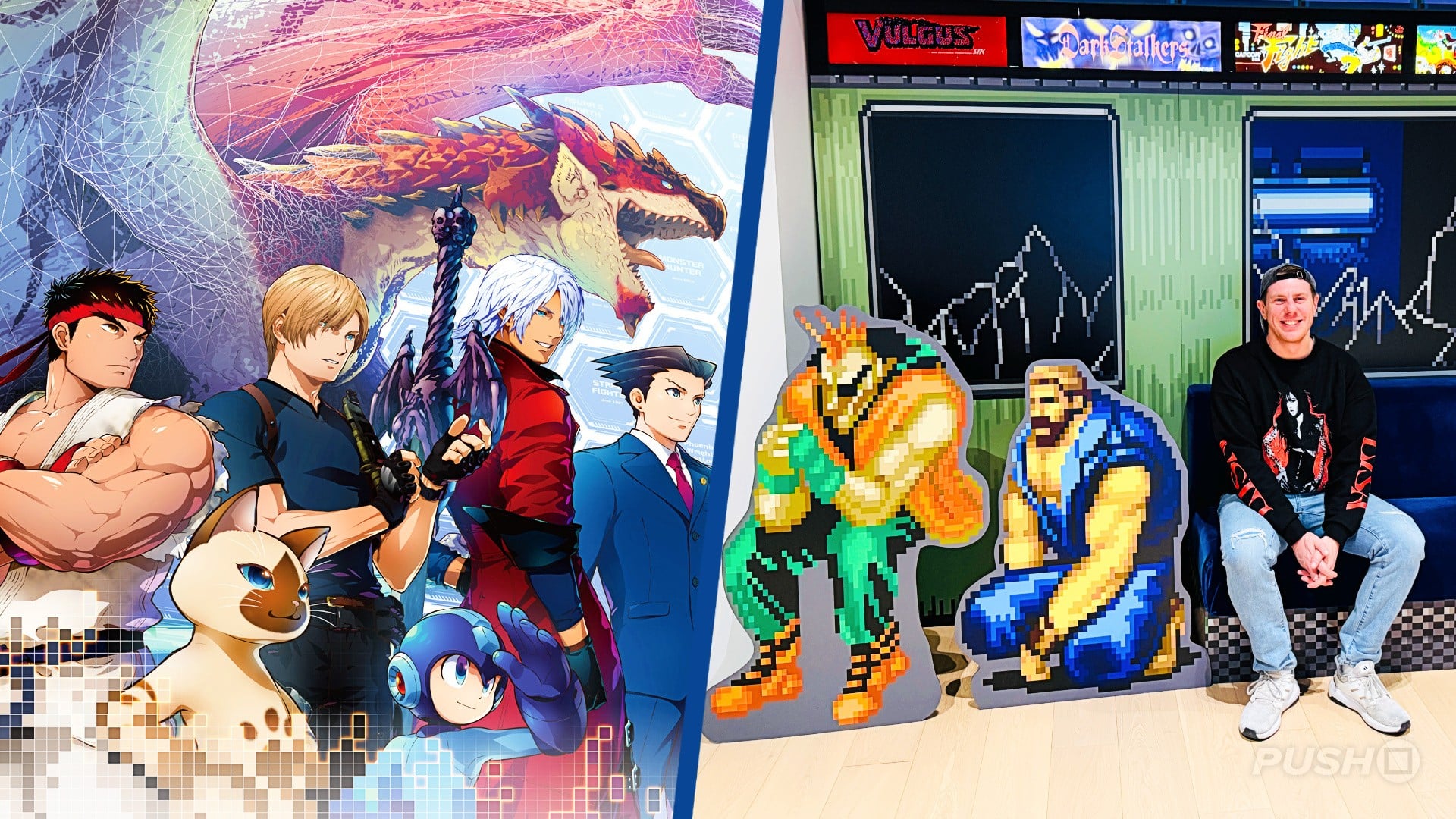
If we polled our readers on their favourite publishers, we suspect Capcom would rank somewhere near to the top.
The Osaka-based organisation has been a mainstay of the video game industry since the early 80s, when it began business as Capsule Computers.
In acknowledgement of its long and prosperous history, last week we were lucky enough to visit Capcom Creation, an art exhibition currently running at Creative Museum Tokyo dedicated to the legendary firm.
Situated a short walk from Ginza in the futuristic Toda Building, the gallery is located on the sixth floor, atop several steep, industrial escalators.
Unlike some stuffy galleries, this museum is spacious and contemporary. Sony has actually exhibited here before, with its interactive Demon Slayer: Kimetsu no Yaiba installation attracting significant fan attention a couple of years ago.
The idea of this museum is to provide a full-body experience which touches all the senses, and while the star of Capcom Creation is the sheer number of original sketches on display (more on that shortly), there certainly is more for you to do at this exhibition than simply sit in the corner and look at the paintings.
With a same-day ticket costing ¥2,900 (~$18.64), entry isn’t exactly cheap, but we spent almost three hours inside so we felt like we got our money’s worth.
The exhibition begins with a message, and then is divided into a series of ‘Rounds’, as in the Street Fighter games.
The introduction reads:
“Since its founding in 1983, Capcom has developed games of all genres. This exhibition aims to show the creativity, ingenuity, and passion Capcom’s creators have used to create the revolutionary game experiences and new ways to play that move the hearts of fans around the world. If you can imagine it, you can create it.”
The first instalment is a projection of various Capcom characters, presented in a unique art style, walking from left-to-right into the gallery itself.
Among the famous faces are obvious inclusions like Resident Evil’s Leon S. Kennedy as well as more obscure heroes such as Regina from Dino Crisis.
While the event leans more into Capcom’s ingenuity than its history, an initial wall plots the background of the company and its relation to the gaming industry at large.
An original PlayStation depicts Sony’s introduction to the medium, which is followed by a small television showing footage of the first Resident Evil, which became a colossal hit upon its release in 1996.
On the opposite wall is an enormous collage of all the company’s various game logos, from the various Street Fighter games to one-offs like the under-appreciated Capcom Sports Club.
Furthermore, a family tree documents the creative evolution of some of the company’s most popular properties, observing how Resident Evil eventually spawned Devil May Cry and the aforementioned Dino Crisis.
Beyond are also installations for various noteworthy characters, including Street Fighter’s Ryu and DarkStalkers’ Morrigan. Depending on the character, the exhibit uses artwork, statues, and/or props to depict their personality and design.
A wall dedicated to original key art, acrylic painted on canvas, held our attention for several minutes – especially when it came to personal favourite franchises, like Final Fight and Street Fighter. We’ve always loved the Magic Sword key art as well.
In addition to this mixture of posters and paintings are glass cabinets with original box art and cartridges, occasionally highlighting the differences between the Western and Japanese designs, as is most famous with the original Mega Man on the NES, of course.
One aspect of the exhibition we found particularly interesting is how it attempts to detail, in an easily digestible format, the work that goes into creating a Capcom game.
So, one section, labelled ‘Creating a Hadoken the Old and New Way’, displays flow charts for the development processes required to create Ryu’s iconic special move in both Street Fighter 6 and Street Fighter 2.
As you’d expect, the steps involved in more modern games are much more complex, and it’s easy to appreciate how the artistry of making games has changed over the past 30 years or so.
The exhibition also encourages you to compare and contrast said hadokens by performing the gesture on two separate arcade sticks. On the left-side you trigger Ryu’s modern character model to attack; on the right-side his Street Fighter 2 incarnation.
What’s cool is that each time someone successfully performs a hadoken, the entire exhibition haul echoes with the iconic speech sample, giving the whole gallery a distinctly Capcom flavour – even if you’re looking at other exhibits.
Other installations in this game creation area include an interactive touch-screen panel dedicated to sound effects, where you can learn how large pipes were used to recreate the sound of Dhalsim’s limbs, among others.
And an area on pixel art explains the techniques Capcom employed to make games like Mega Man, working within the confines of the Famicom’s limited colours and tile sets to create waterfall effects and epic boss fights.
In fact, you’re encouraged to recreate your own pixel art character by manually colouring in different pixels, a la Picross. We selected Haggar from Final Fight and spent several minutes making him. You can scan a QR code to download your creation and save it to your phone.
In addition to its work on older, sprite-based games, Capcom is also eager to show off how its techniques have evolved in the 3D era.
One section features Nero’s jacket from Devil May Cry 5, the original real-life prop which it used contemporary photography techniques to scan into the game.
But everything is connected to the past, and a series of design documents produced during the pixel art era showcase a kind of ‘Character Creation Manual’ which the company still regularly references. These detail specifics such as proportions and body types which helps ensure all of the company’s characters have a distinctive, recognisable look – regardless of genre, theme, or style.
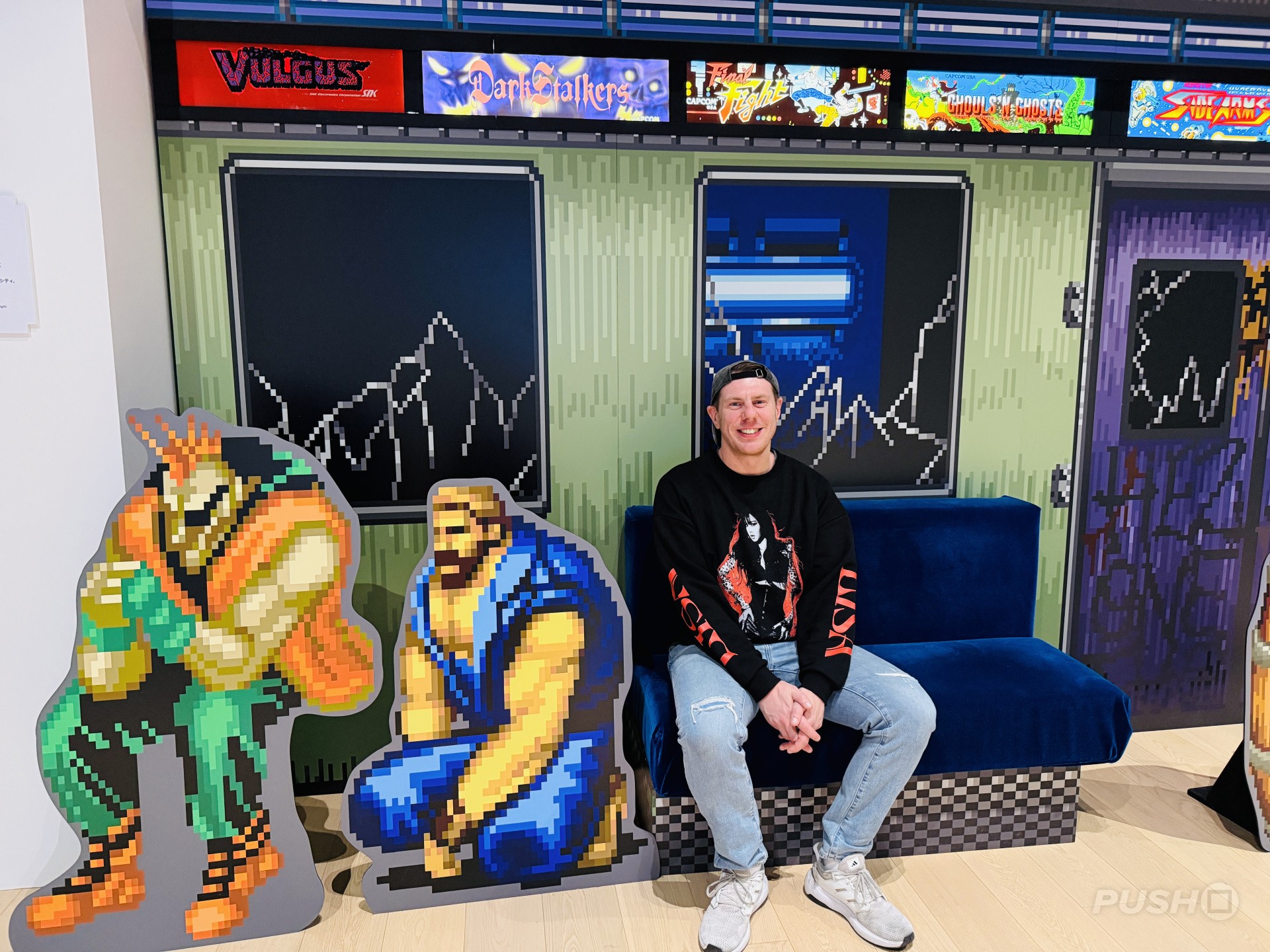
While the exhibition is generally quite light on Resident Evil, one interactive activity we unfortunately weren’t allowed to photograph sees you ushered through a dark corridor armed with just a torch.
This works via infrared, detecting where you’re pointing the torch and turning on different screens, giving the illusion you’re lighting up your surroundings. Along the way you’ll encounter different enemies from the Resident Evil games, including a Licker on the ceiling.
A trio of television screens at the end of this area show how the company has consistently altered the camera in the Resident Evil games to enable different experiences, from the fixed perspectives of the original game through to the over-the-shoulder viewpoint of Resident Evil 4 and more recently the first-person titles.
But the end of the gallery is what really dropped our jaw: several walls of original design documents, sketches, character concepts, and artwork from the likes of Street Fighter 2, DarkStalkers, Rival Schools, Final Fight, and Mega Man.
Staring at some of the sketches of, say, Cody’s iconic walking animation in Final Fight genuinely stirred an emotional reaction in us. Similarly, seeing familiar locations like E. Honda’s bathhouse stage from Street Fighter 2 mapped out on graph paper felt surreal.
The gallery ends with a ‘Bonus Round’ – an interactive area using performance capture technology where you’re encouraged to pick a Capcom character and pose. There’s also a similar activity earlier in the exhibition that focuses on facial capture, too – both are neat.
And then before the exit, there’s an opportunity to leave a message, with some displayed on the wall. As you’d expect, several incredible artists have already attended the exhibition and sketched some stunning fan art. We’re not particularly good at drawing, so we settled for a simple hand-written message instead.
While the gallery is relatively small, we thoroughly enjoyed its presentation. The mixture of artwork and interactive activities feels just right, and we think it does a great job of showcasing how game development has changed over the years.
Whether it’s figuring out how to extract the maximum amount of power from the Famicom, or pushing the boundaries of visual presentation on the PS5, it’s actually quite an enlightening exhibition – even if you’re an engaged player who’s already fairly familiar with the various stages and aspects of game development.
The only small criticism we’d share is that the exhibition is light on Resident Evil, with no design documents or artwork for that franchise in particular. We suppose the survival horror series is big enough to get its own full-scale event in the future, but we still would have liked to have seen some sketches from the series.
But either way, Capcom has been at the top of its game for decades now, and this exhibition reinforced that. On the eve of Resident Evil Requiem and Pragmata, it was inspiring to take a peek behind the curtain and celebrate the company’s unstoppable run since its inception in the early 80s.
Capcom Creation is open now in Tokyo, and will run through 22nd February. You can find out more information about the exhibition on its official website through here.