Breitbart Business Digest: Treasury Secretary vs. The Regulatory Woketopus
Written by admin on December 13, 2025
Fed Elves Rebel, AI Discovers Gross Margins, Hollywood Money Gets Complicated, and Treasury Takes on the Woketopus
Welcome back to Friday. This is the Breitbart Business Digest weekly wrap, in which we coincidentally run through the economic and financial news of the previous seven days.
It was the final Fed week of the year and Saint Jerome came down the chimney with a rate cut for all the good little boys and girls, despite the objections from several naughty central banking elves. Shares of Oracle and Broadcom were pummeled by investors worried that there may be a bit more artifice and less intelligence to the AI boom. Treasury Secretary Scott Bessent is attempting to slay woke-to-broke banking regulation. Paramount is still fighting to get Warner Bros Discovery to cancel its Netflix subscription.
Cacophonous Jingle Bells at the Fed
The Federal Reserve was widely expected to deliver a “hawkish cut” at the conclusion of this week’s Federal Open Market Committee (FOMC) meeting. It delivered the cut, but it was significantly less hawkish than expected. The summary of economic projections showed the median rate cut expectations were unchanged from September, with the fed funds rate expected to fall to 3.4 percent next year and 3.1 percent after that. The longer-run forecast, which many thought might move up a tad, remained anchored at three percent.
The median expectation for inflation next year actually came down from 2.6 percent in September to 2.4 percent. This year’s expectation also fell, an admission that Fed officials overestimated inflation this year. Combined, this means that the Fed is finally getting over its Scrooge-like conviction that the absence of tariff-led inflation now means more tariff-led inflation in the future.
At the same time, the Fed upgraded its growth expectation for next year. GDP is now expected to rise 2.3 percent, up from 1.8 percent in September. The expected unemployment rate was unchanged at 4.4 percent. What’s not to like? Less inflation, declining interest rates, faster growth, and unemployment steady at a low rate. Deck the halls, lads and lasses.
But it somehow did not feel like Christmas at all. Fed Chair Jay Powell looked a bit bewildered and exhausted by it all. Two voting members of the FOMC dissented, grousing that the Fed should not be cutting with inflation above target. Six of the dots—anonymized symbols for the broader committee group of 19 that contribute to the summary of economic projections—signaled that they thought the Fed had gone too far in cutting this year. The dots for next year were all over the place, signaling a complete lack of consensus.
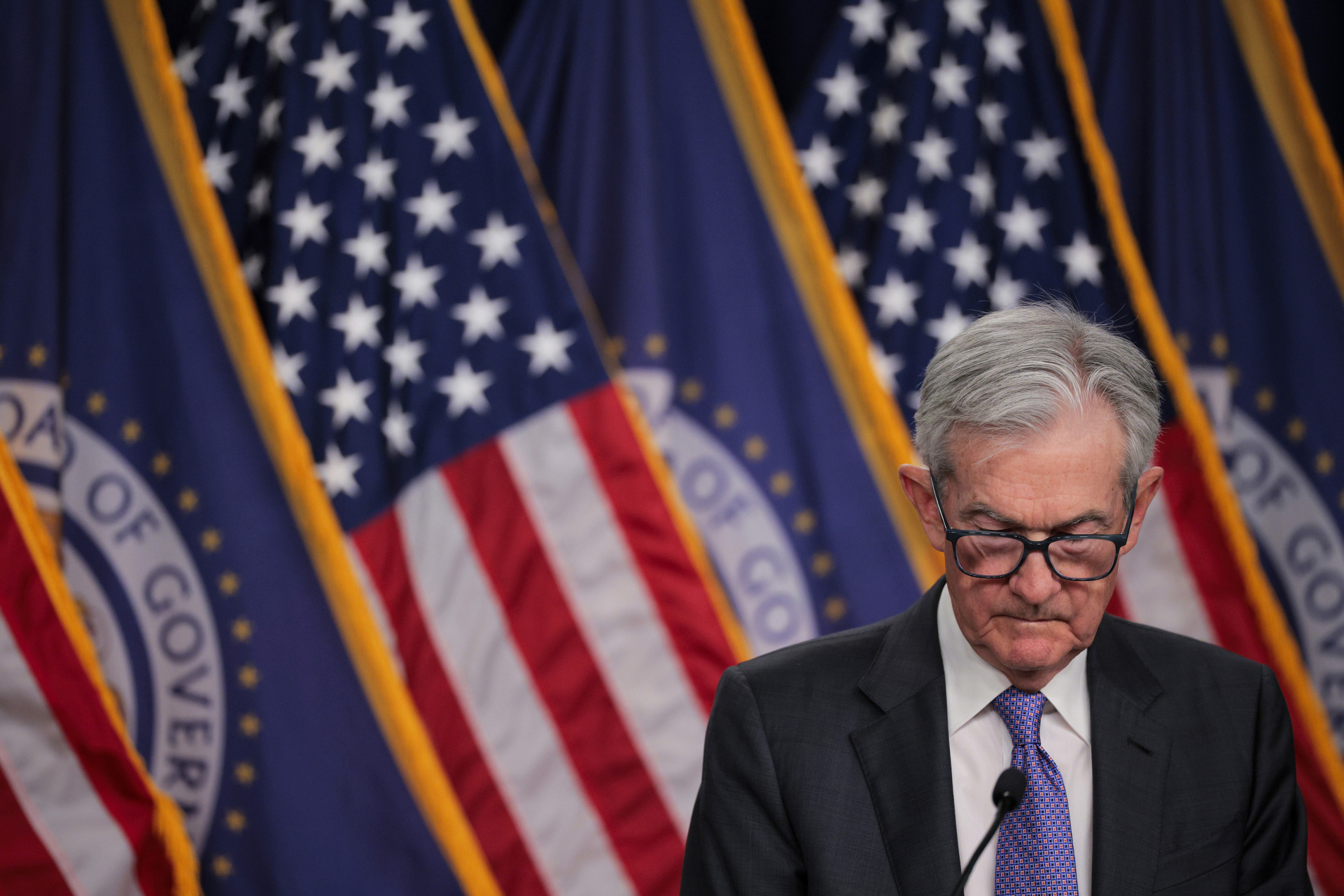
Federal Reserve Chair Jerome Powell pauses while speaking during a press conference following the Federal Open Markets Committee meeting on December 10, 2025 in Washington, DC. (Chip Somodevilla/Getty Images)
Powell refused to say that he would step down from his governor position when his term as chair ends next year. This is looking increasingly irresponsible. If Powell is going to step down, President Trump will need to appoint a replacement. Dragging it out creates additional uncertainty at a moment when everyone complains that uncertainty is an economic drag. Just say you’ll go when you surrender the chairmanship of the Fed, Jay. Why the hesitation?
The AI Trade Gets Ugly
The AI trade took a quick one-two this week—first from Oracle, then from Broadcom—and it landed hard enough to make even the “infinite total addressable market” crowd check their wallets. Oracle rattled investors by effectively saying, “Remember that capex number we gave you in September? Add another $15 billion for fiscal 2026,” a reminder that the road to machine intelligence is paved with invoices, debt, and very expensive concrete. A Bloomberg report didn’t help, either, saying Oracle has pushed back completion dates for some data centers it’s developing for OpenAI to 2028 from 2027.
Then Broadcom piled on, warning that growing sales of lower-margin custom AI processors are squeezing profitability. Translation: yes, the demand is real, but the dream is starting to come with a receipt, and a less flattering gross margin line. The result was a small tech wobble that felt less like “the bubble popped” and more like “the market remembered math exists.”
Paramount Brings a Billionaire; Warner Requests a Receipt
Hollywood’s newest takeover soap opera has a simple plot: Paramount keeps insisting “money is no object,” and Warner Bros. Discovery keeps asking, politely, “Cool—whose money, exactly?” Paramount’s pitch to WBD leaned heavily on Larry Ellison as the ultimate backstop, but WBD’s board wasn’t thrilled that the support wasn’t wrapped in a personal guarantee—and that the equity contribution was described as coming through a revocable trust structure, the kind of “funds certain” that can feel a bit like “funds… probably.”
That skepticism helps explain why WBD went with Netflix’s proposal for its studios and streaming assets, a bid the board viewed as cleaner and more bankable, backed by a giant with an investment-grade balance sheet and real cash on hand. Paramount’s counterattack is to take the fight to shareholders (and to the court of public opinion), arguing it offered a better deal and that WBD never even raised its concerns directly.
Now the fun part: Paramount is in “protracted battle” mode, WBD is constrained by deal protections in the Netflix agreement, and the market is doing what it always does during a brawl—nudging the target’s stock higher on the assumption someone will blink and pay up. It’s the kind of situation where everyone swears they’re being rational adults while using phrases that translate to “see you in discovery.”
Scott Bessent vs. The Woketopus of Bank Regulation
Years ago, when the post-financial crisis Congress enacted Dodd-Frank and created the Financial Stability Oversight Council (FSOC), critics warned that giving regulators too much power over the banks would inevitably lead to various factions trying to force their political agendas on the economy in the name of safety and soundness. Supporters of FSOC swore up and down no such thing would happen and then promptly spent the next decade trying to get bank regulators to push a climate change, DEI, and anti-gun agenda in the name of “reputational risk.”
Treasury Secretary Scott Bessent appears in the in the Oval Office of the White House on September 25, 2025, in Washington, DC. (Andrew Harnik/Getty Images)
The theory of “reputational risk” was that it was reputationally risky to do things progressives do not like. That sounds dismissive, but that’s really all there was to it. Take the concept of “transition risk,” which was the version they tried to push for climate change. It said that one day or another, the government and the public were certain to adopt the far-left’s anti-fossil fuel views, so lending to or investing in oil and natural gas-related projects was overly risky.
Treasury Secretary Scott Bessent this week decided the arc of history doesn’t have to bend toward woke bank regulation, especially when it bends the credit system in half. At an FSOC meeting tied to the council’s 2025 annual report, Bessent argued that economic growth and economic security aren’t trade-offs against stability; they’re prerequisites for it. Translation: if regulators choke off lending, hamstring market-making, and turn supervision into a slow-motion political veto, they don’t get to call the resulting stagnation “prudence.”
It’s early, and the regulatory class will fight like a cornered octopus. But the direction is clear: FSOC is being told to stop acting like a cultural enforcement arm and start acting like a financial stability council again. Amazingly, the same people who spent years insisting politics didn’t belong in bank supervision are now claiming—without blinking—that removing politics is “hands-off.”
Drake and the Moon
This weekend marks two departures at very different scales and in very different directions. On December 13, 1577, Francis Drake sailed from Plymouth at the start of the voyage that would become the first English circumnavigation of the globe. And on December 14, 1972, Apollo 17’s lunar module lifted off from the Moon to rejoin the command module in orbit, closing the last chapter—so far—of humans on the surface of our stellar little sister. One launch set out to map the world, the other closed the chapter on our first steps beyond it.