- A sequence of disasters in late 2025, including floods, landslides, and a rare cyclone in Sumatra, killed more than 1,100 people and devastated communities and wildlife in landscapes already weakened by forest loss.
- Public anger and political attention have converged, with deforestation emerging as a central topic of national debate and senior Indonesian leaders acknowledging failures in forest protection and governance.
- Amid tragedy, there are signs of possibility, as investigations, policy commitments, and evidence of resilient wildlife suggest Indonesia still has a narrow window to change course and protect its remaining forests, argues Aida Greenbury, a sustainability leader and forestry expert with decades of experience in Indonesia’s forest sector.
- This article is a commentary. The views expressed are those of the authors, not necessarily of Mongabay.
It was 27 December 2004. I was sitting at my computer in my office in Jakarta, Indonesia, my mind busy with plans for the New Year party I had organized with friends in the city, when my phone started ringing nonstop. First came a call from colleagues, frustrated that our North Sumatra office wasn’t picking up. Then others told me to check the news online. What I had expected would be an exciting end-of-year celebration slowly revealed its darker reality. A megathrust earthquake had triggered a massive tsunami that devastated Aceh in Sumatra. Officials estimated that more than 200,000 people died.
In November 2025, the nightmare returned. The 2025 wet season began earlier than usual in Indonesia. In September, the Meteorology, Climatology, and Geophysics Agency warned that hydrometeorological hazards, including floods and landslides, could strike parts of the country, with November to December identified as the peak rainy season for Sumatra and Kalimantan. Most people did not take the warning seriously. Videos of urban flooding circulated on social media. But one eerie video caught my attention on 26 November 2025. The blurry footage showed dozens of people squatting on a forested hill in heavy rain, wrapped in makeshift raincoats. “Please help us. We are in the middle of the forest, surrounded by landslides,” the person recording shouted, just before the phone network died. A day earlier, on 25 November, more than 50 people had been trapped in a forested area of Tapanuli, North Sumatra, for two nights after floods and landslides struck.
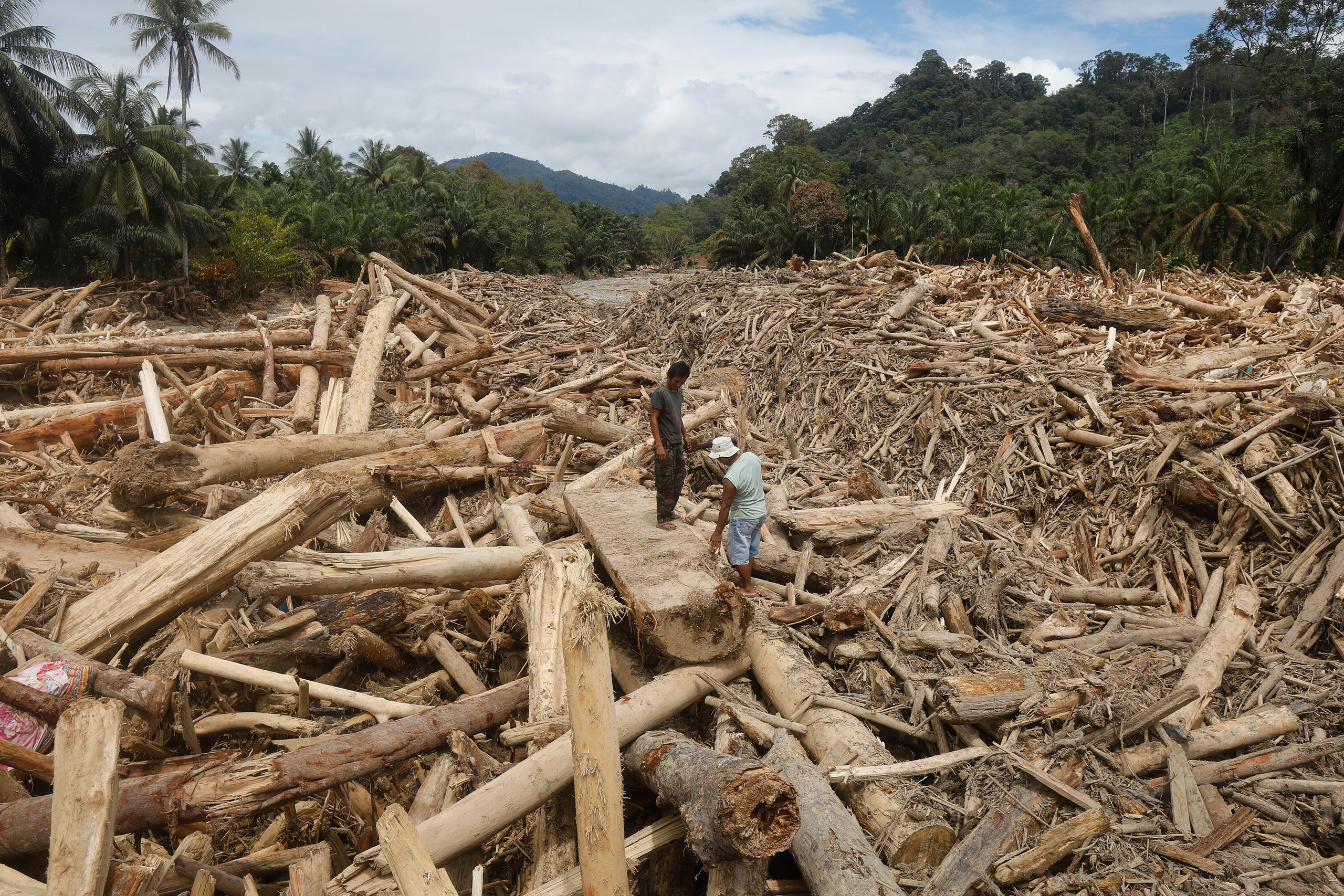
From that moment, the disasters came one after another. For years, ecosystems in Aceh, North Sumatra, and West Sumatra had been weakened by deforestation and land-use change. The regions lost 1.4 million hectares of forest in the past decade alone. So when a rare tropical cyclone hit in November 2025, the result was catastrophic. It felt like watching a film about the forest’s wrath. With canopies already opened, intense rainfall battered degraded topsoil, eroding the forest floor and mobilizing logs and post-logging debris left behind. Thousands of tonnes of timber, some from century-old giant trees, surged through muddy floodwaters, destroying everything in their path—houses, mosques, bridges, and human and non-human lives alike. As of 4 January 2026, 1,167 people had been recorded as having lost their lives. Endangered wildlife, including Sumatran elephants and Tapanuli orangutans—the world’s rarest great ape—were also among the victims. Parts of Aceh remain affected by flash floods more than 40 days after the first major event.
With tonnes of logs swept into their living rooms, people in Sumatra do not need to be experts to know whom to blame. Their anger has been compounded by the sight of trucks continuing to haul timber even as communities remain buried in mud—business as usual, including deforestation in conservation buffer zones.
I am a forester with firsthand experience in natural-forest logging. I remember standing beside a freshly cut two-meter-long log in East Kalimantan in the late 1990s, and later helping make decisions to convert natural forests into plantations in the early 2000s. Yet it is now 2026, and despite decades of standards designed to prevent deforestation and protect conservation values, the lessons have still not been fully learned. Why have we waited for climate catastrophe and ecosystem collapse before seriously considering an end to forest destruction? How many more lives must be lost to greed and reckless development before meaningful change occurs?

One positive outcome of the Sumatra disaster is that more Indonesians are now openly discussing the impacts of deforestation. This matters because speaking out against deforestation can often feel isolating, dismissed as irrelevant. In my decades in Indonesia, I have never seen deforestation become such a prominent topic in public discourse. Traditional media, online platforms, and social media are now filled with discussion. By the end of 2025, the conversation extended well beyond activists to include students, parents, academics, and senior politicians.
Even political elites have begun to speak out. On 9 December 2025, Indonesia’s Defence Minister, Sjafrie Sjamsoeddin, stated in a public address that floods and landslides in Sumatra and Aceh were evidence that protected forests were not being properly managed. He emphasized that these forests must be preserved. President Prabowo Subianto has echoed this message on several occasions, most recently in his New Year’s message on “Honouring and Safeguarding Nature.” “Our nation is vast, beautiful, and thriving, but we must be conscious of our environment,” he said. “We should respect, preserve, and nurture nature.”
In response, more than a dozen companies have been investigated for allegedly contributing to disasters in Aceh, North Sumatra, and West Sumatra through forest-conversion activities in watershed areas. The government has also reaffirmed its commitment to comprehensive reforms in natural-resource management to prevent similar disasters.
These statements are encouraging, but trust will depend on whether actions follow words. The path forward is difficult but feasible. Indonesia already has a foundation for improved forest governance, including high conservation value and high carbon stock approaches, as well as essential ecosystem area guidelines issued by the Forestry Ministry. This framework must be strengthened through international standards such as the Accountability Framework and the EUDR to support responsible trade in Indonesian products. Crucially, these standards must be implemented through proper consultation processes and with the consent of local communities. Landscape-scale approaches that consider carrying capacity, ecosystem resilience, and watershed rehabilitation must also be prioritized.

Between 2002 and 2024, Indonesia lost 11 million hectares of its primary humid forests. Further losses risk triggering even more severe warnings from nature. Political will remains the most critical factor in halting deforestation, and Indonesia currently has that support at the highest levels. Initial efforts should focus on areas most vulnerable to floods and landslides, as well as biodiversity hotspots such as Papua. Claims of commitment to conservation will ring hollow if deforestation continues there, particularly when development proceeds without local consent or involves companies that disregard biodiversity and harm wildlife.
Not everything in 2025 ended in despair. There was good news that offered a rare moment of relief. Three tiger cubs were seen playing with their mother in a healthy forest in Way Kambas National Park in November. Meanwhile, a robust tiger population—among the healthiest on the island—has been identified in Leuser’s remote and intact forest landscape. These sightings are a reminder that ecosystems are not yet beyond repair. They offer a glimmer of hope for 2026, and a signal that Indonesia still has the opportunity—and now the public and political will—to respect, preserve, and nurture its forests.

Aida Greenbury is a sustainability leader and forestry expert specializing in responsible land use, no-deforestation policies, and sustainable supply chains across Asia. With more than two decades of experience, she has advised governments, NGOs, and global corporations. She previously served as Managing Director of Sustainability at a major forestry and paper company, where she developed zero-deforestation commitments, and continues to champion smallholder inclusion and climate-resilient land use through advisory roles.
Header image: Tame Sumatran elephants were brought in to help clean up flood-affected residential areas in Meunasah Bie village, Meurah Dua district, Pidie Jaya. Image by Junaidi Hanafiah/Mongabay Indonesia.
Credits