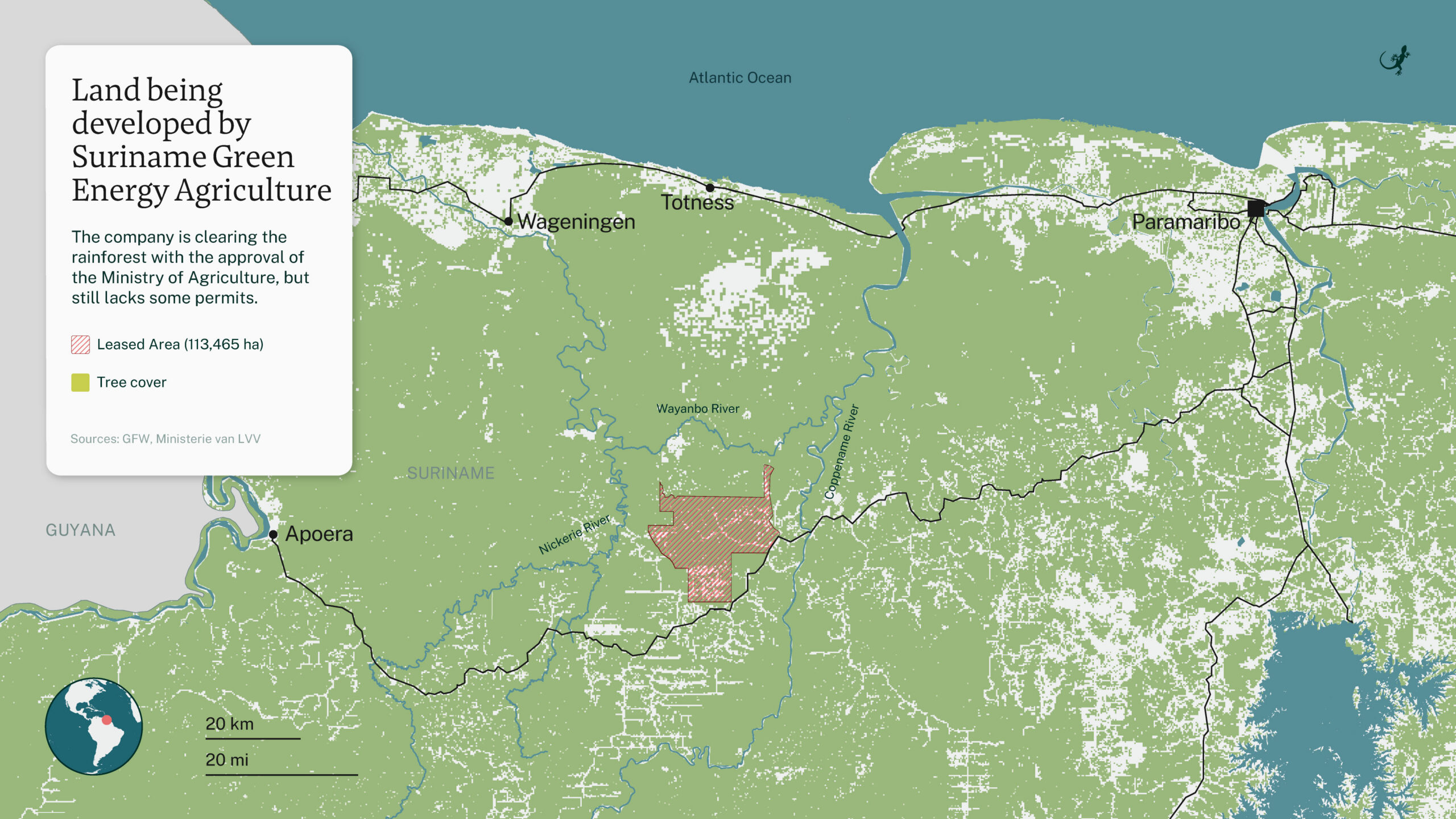
- Critics in Suriname are speaking out against plans to develop 113,465 hectares (280,378 acres) of rainforest for industrial agriculture in the district of Nickerie.
- The plans come from a 2024 public-private partnership between the agriculture ministry and Suriname Green Energy Agriculture N.V., a private company working in sugarcane ethanol and bioenergy.
- The partnership was inherited from the previous government and allegedly went forward without environmental permits, causing frustration and confusion across several regulatory agencies.
- If the entire 113,465-hectare block is cleared, Suriname could lose its negative carbon emission status and fail to qualify for certain carbon credit programs, experts said.
Officials in Suriname are trying to cancel a controversial agribusiness contract that could result in the clearance of over a hundred thousand hectares of Amazon rainforest, risking the country’s carbon-negative status.
In 2024, the agriculture ministry partnered with a private company to develop 113,465 hectares (280,378 acres) of rainforest for industrial agriculture in the northwestern district of Nickerie. Although development wasn’t immediately carried out, the legal framework remains in place and has allowed clearing to begin in recent months.
“This is not just a local issue. This is a regional issue because of the role rainforests play on the continent,” John Goedschalk, a climate advisor to Suriname’s president, told Mongabay. “The continued deforestation in the Guiana Shield endangers access to water for people all the way to Argentina.”
The land is being developed through a public-private partnership between the Ministry of Agriculture and Suriname Green Energy Agriculture N.V., a private company working in agriculture and bioenergy.
The company began clearing the forest despite not receiving permits from the National Environmental Authority (NMA), government officials said in internal emails reviewed by Mongabay. The area almost completely overlaps with logging concessions regulated by multiple-use and sustainability regulations designed to protect primary forest.
The company has also hired Mennonites, members of a conservative Protestant denomination, to work on the land, reigniting fears that the religious group will establish large farming communities that rapidly expand into forested areas, as has happened in other parts of the region.
Suriname Green Energy Agriculture and the agriculture ministry didn’t respond to Mongabay’s requests for comment.
If the entire block of forest is lost, it could have wide-ranging environmental and political implications for Suriname, Goedschalk said.
“You can forget the carbon-negative status,” he said. “That means we’ll also lose access to our carbon credits. We would no longer be carbon negative. Forget about it.”
Old land deals, new controversies
This isn’t the first time the government in Suriname has tried to develop large-scale agribusiness in the Amazon.
In 2023, control of more than 500,000 hectares (1.2 million acres) was transferred from Suriname’s forestry agency to the agriculture ministry, with the intention of developing agribusiness projects for the public and private sector, documents obtained by Mongabay at the time show.
Another initiative would have transferred 30,000 hectares (about 74,000 acres) to Mennonite families from Bolivia looking to establish new farming communities.
Then-President Chan Santokhi, whose office oversaw all of these plans, emphasized the need for economic diversification in Suriname as the country battled inflation and sluggish growth. The plans prompted a public backlash and were never carried out, with critics pointing to the importance of the country’s 93% rainforest cover and carbon-negative status.
“Forest and freshwater ecosystems are already affected by [illegal] gold mining,” WWF-Guianas director David Singh told Mongabay in 2023. “Large-scale agriculture should not become a second driver of deforestation.”
Santokhi left office in July 2025 and was succeeded by Jennifer Geerlings-Simons, the former chair of the National Assembly and an outspoken critic of deforestation. But her government didn’t take the necessary steps to reverse the land deals created by the previous government, critics pointed out.
Her office didn’t respond to a request for comment.

“Nobody knows what is happening,” Erlan Sleur, a biologist and president of the environmental NGO ProBios, said of the land deals. “Even the people in the new government don’t know what is happening.”
Part of the confusion comes from miscommunications between government agencies and a failure to follow standard environmental protocols, critics said.
Projects involving land clearing in Suriname are supposed to receive approval from the Foundation for Forest Management and Production Control (SBB), a government agency overseeing sustainable forestry. But that didn’t happen with the area being developed by Suriname Green Energy Agriculture.
SBB officials were caught off guard by the deal, according to the internal emails reviewed by Mongabay and officials who agreed to speak on the condition of anonymity because they were concerned about keeping their jobs.
One senior SBB official expressed frustration about their office’s exclusion from the standard process and said the Santokhi administration may have deliberately sidestepped the SBB for that specific deal, knowing its input would compromise the project.
“They know it had to come through [the SBB] and that we would have rejected it, because we are against agriculture in primary forests,” the senior official said. “We have plenty of secondary forests. We have tertiary forests.”
Officials in multiple agencies are exploring ways to halt the development before more of the forest is destroyed.
So far, their focus has been on whether Suriname Green Energy Agriculture started clearing the land before receiving permits from the NMA, according to internal emails.
“We might be able to cancel this contract just on that basis,” Goedschalk said.
Banner image: Flamingos in Bigi Pan, Nickerie, Suriname. Image by Jeroen van Luin. CC BY 2.0.
See related from this reporter:
Suriname’s plan to capitalize on carbon: Q&A with President Jennifer Geerlings-Simons
FEEDBACK:Use this form to send a message to the author of this post. If you want to post a public comment, you can do that at the bottom of the page.
Credits