AI Reality Check: What Business Leaders Think of Artificial Intelligence
Written by admin on January 15, 2026
With artificial intelligence dominating global business news, we wanted to gain insight into how corporate executives are thinking about AI implementation. Is AI a good or bad thing? How much are they using AI, and what benefits are they seeing? How are they adjusting organizational processes and structures in light of AI?
In conjunction with The Official Board, we sent a survey to corporate executives in June 2025. We received 240 responses, well diversified by industry and region. What we learned is that there is a disconnect between the splashy AI news headlines and what executives are seeing in practice. According to these executives, the AI myths do not reflect the AI reality.

Myth: AI is a threat. “Experts predict ‘superintelligent’ AI could build a robot army to wipe out the human race,” proclaimed a 2025 New York Post headline
Reality: Despite the dire AI headlines, executives we surveyed were overwhelmingly positive about the potential benefits that AI offered. When asked whether they viewed AI as a threat or opportunity, 87 percent of executives saw AI as an opportunity for their organization. Only 2 percent saw it as purely a threat. And 11 percent were neutral/mixed on its impact.
Executives highlighted several specific AI-related opportunities. First, AI-driven productivity gains will allow organizations to move quicker and accomplish more. AI “will enable us to do more (expanding) and better (work) with less (people and capital),” stated one executive. Second, AI’s ability to execute rote tasks will allow more time for creative/value-added tasks, leading to better outcomes for the organization and an improved working environment. Third, AI tools can provide better and faster customer service. Fourth, AI will boost data analysis capabilities. “We can process data and assess data far more quickly to make quicker more informed decisions,” stated one executive.
“We have a lot of data and information that has not been tapped and AI can generate a lot of value if used correctly,” stated another.
Executives who were more mixed in their assessment of AI highlighted the risks that AI posed if used poorly. AI “is a threat if the user is blindly following AI results due to ignorance, laziness in fact-checking or indecision,” stated one manufacturing company executive. They also expressed concerns about data security. One executive of a chemicals company explained, “For us to utilize AI, highly sensitive technical information must be used as inputs. Sending highly sensitive confidential information to an uncontrolled external server or cloud is an unacceptable risk at this time.”
Another suggested that the AI hype was overblown. “It is just another tool among many tools available,” they said.
Finally, AI’s role as a disruptor was described as a positive or negative, depending on the organization’s market positioning.
Myth: AI has already transformed organizations
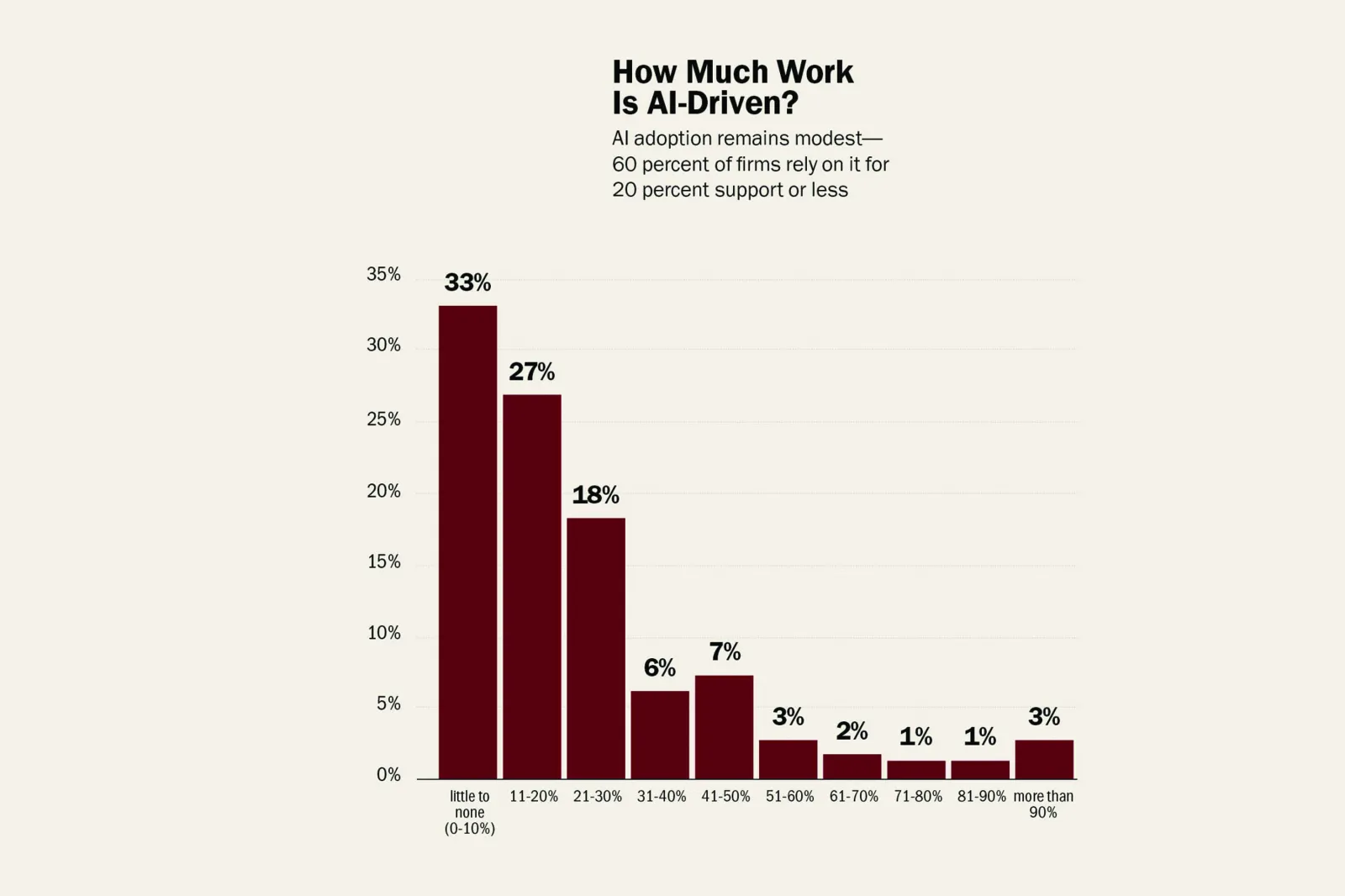
Reality: Most organizations are just beginning their AI journey. Sixty percent of respondents reported that 20 percent or less of their organization’s work is currently supported by AI tools (right). This reliance on AI tools is broadly similar across regions. From an industry perspective, the differences were relatively small; manufacturing companies reported the highest usage (roughly 22 percent of work supported by AI tools) and health care had the lowest usage (about 17 percent).
Myth: Companies are generating significant economic returns from their AI investments
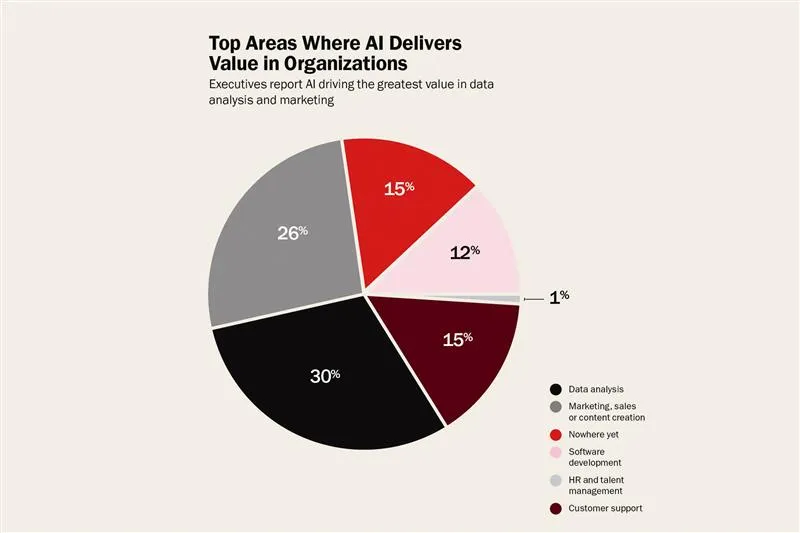
Reality: Fifteen percent of respondents shared that their organization has yet to realize any value from AI investments. From an industry perspective, health care was a noted outlier, with 30 percent of executives reporting that they are not seeing value from AI investments.
Myth: AI has limited-use cases
Reality: AI is generating value in many areas. Across all industries and regions, executives are seeing the most value from their AI investments in data analysis and marketing (see chart, next page). Technology executives reported that AI was generating the most value in marketing, followed by software development; finance executives highlighted data analysis followed by customer support. On a regional basis, 27 percent of Asia-Pacific executives are seeing the most value from their AI investments in customer support (compared with only 12 percent of executives in Europe, the Middle East and Africa and 9 percent in North America). Twenty percent of North American executives cited software development as the area where AI is generating the most value (vs. 4 percent in APAC and 12 percent in EMEA).
Myth: Many workers are resistant to AI
Reality: Only 11 percent of the executives we surveyed saw resistance to upskilling and adapting to AI. Regionally, APAC employees are most open to AI. Fifty percent of APAC executives viewed their teams as “very open” to AI upskilling and adaptation, compared to 37 percent of EMEA and 40 percent of North American executives.
Myth: You need to be AI savvy to get a job today
Reality: More than 60 percent of executives surveyed reported that a candidate’s AI knowledge has little to no influence on the organization’s general hiring processes. One executive shared, “Our recruitment practices have not been upgraded yet to cater for and understand AI as a competence or skill.” Another explained, “AI [is] still not considered as an asset for candidates applying in roles. This is because the level of understanding in AI is pretty poor in my organization—including myself.”
Numerous respondents stated that an assessment of AI knowledge was not incorporated into the general hiring process, but it was a factor when hiring for certain departments/roles. And, some explained that AI know-how is a small but growing factor in their hiring processes.
Myth: Executives are losing sleep over fears of obsolescence due to AI
Reality: Over half of executives believe there is little to no likelihood of their job becoming obsolete over the next five years. (Only 1 percent believe that that likelihood is greater than 90 percent.)
Myth: Employees are hiding their use of AI tools (particularly large language models like Chat GPT) at work
Reality: Fifty-seven percent of executives reported that employees were somewhat/very transparent regarding AI usage. Only 2 percent found that employees kept their AI usage “very hidden.”
Myth: Executives are spending all their time “ChatGPT-ing”
Reality: Over 80 percent of executives are spending five hours or less each week learning to use AI. It is particularly striking how little time N-1 executives (direct reports to CEO) are spending on AI; only 3 percent of N-1s devote more than 10 hours per week to AI learning (compared with 13 percent of CEOs and 13 percent of N-2 executives). Regionally, North American executives are spending more time learning about AI (14 percent reported devoting more than 10 hours per week to AI learning) than APAC (8 percent) or EMEA (4 percent) executives.
Myth: Technological know-how will be the most important skill in the AI-transformed world of work
Reality: A wide range of skills will continue to be critical. We asked executives which three skills they expected to be most critical in their “AI-transformed organization.” Critical thinking and decision-making was the top vote-getter (22 percent), then data analysis & interpretation (18 percent). Human collaboration and empathy ranked last (7 percent).
Myth: Technology companies are leading the AI charge
Reality: Technology company executives reported AI usage statistics similar to other industries. Only 5 percent of technology executives reported that more than half of their organization’s work is supported by AI tools, and 15 percent reported that the organization is not yet seeing value from AI investments. Eighty percent of tech executives are spending five hours or less each week learning about AI, and just 40 percent described their employees as “very open” to AI. These statistics are in line with survey-wide statistics.
Myth: AI agents are replacing humans in organizational charts
Reality: Executives continue to manage teams of human employees. Over 70 percent of executives surveyed are spending upwards of 75 percent of their time leading human teams.
Despite the headlines, most executives are not living in fear of the AI apocalypse; they are overwhelmingly positive about AI’s potential. While it is still early, and there is no overnight AI transformation, executives agree that AI is here to stay. One executive concluded, “There’s really no choice but to embrace it and figure out how and when to use it effectively to benefit the customer and employee experience.”
Boris Groysberg is a professor of business administration in the Organizational Behavior Unit, and Sarah Abbott is a research associate, both at Harvard Business School.