Franchise power: How Light & Wonder keeps players coming back for more
Written by admin on January 15, 2026
As competition intensifies across the gaming business, long-term success is increasingly driven by creating games players return to, rather than chasing constant release cycles. Marco Bettio, EMEA senior director of product management at Light & Wonder, explains how franchise-led development and disciplined evolution turned one standalone success into a scalable, long-running franchise.
In a crowded gaming landscape, success is increasingly defined not by the next launch, but by what lasts. Across casino, online and social channels, operators and suppliers face the same structural challenge: how to build games that remain relevant beyond their initial release window, in an environment where development cycles are shortening and marketing costs continue to rise.
Those pressures are well documented. Analysis cited by the UK House of Lords shows that marketing alone can account for around 10% of gambling industry revenue, while suppliers continue to invest heavily in R&D to meet rising player expectations. Against that backdrop, constantly starting from scratch is an expensive strategy. Building on existing successes offers a way to amortise creative, technical and marketing investment over time, while reducing the risk associated with every new launch.
This is where the franchise model comes into play. In gaming terms, a franchise is not simply a sequel or a reskin, but a structured approach to product development that builds multiple games around a recognisable core – shared mechanics, themes and player expectations. By extending a successful concept rather than replacing it, studios can reuse proven foundations, refine ideas over time and reduce the cost and uncertainty associated with each successive launch. For operators, franchises offer familiarity and predictability; for players, they deliver confidence and continuity.
For franchising games, the opportunity lies in creative continuity, disciplined innovation and a clear understanding of player expectations. Few examples illustrate that balance better than the Huff N Puff franchise from Light & Wonder (L&W), which has grown from a single hit into one of the company’s most consistent long-term performers.
Adding long-term value
Huff N’ Puff did not begin as a franchise by design, but its evolution reflects a deliberate understanding of what gives a game long-term value. Since the launch of Lock It Link
Huff N Puff, the title has grown into a family of more than eight games, performing across land-based, online and social channels in multiple regions.
According to Marco Bettio, EMEA senior director of product management at L&W, that expansion has been driven by its DNA – a clear definition of what must remain consistent from one release to the next.
“Huff N Puff derives from the popular fairy tale of the Three Little Pigs,” Bettio says. “From a concept perspective, the story is about creating and destroying. During the bonus, players build houses across the reel matrix before the wolf removes them at the conclusion and delivers player rewards.”
This structure has remained unchanged across every iteration. It is not superficial – it is the game’s DNA.
For Bettio, who has worked in gaming for three decades, establishing that expectation early is critical. Each new Huff N Puff title begins from a familiar place, allowing players to engage immediately rather than relearn mechanics. That familiarity creates confidence, while leaving space for creativity around the edges.
Evolving without losing focus
Rather than reinventing the experience, Las Vegas-headquartered L&W has expanded Huff N Puff by introducing carefully chosen additions that enhance the core loop. Each new release is designed to offer something new to explore, but never at the expense of recognizability.
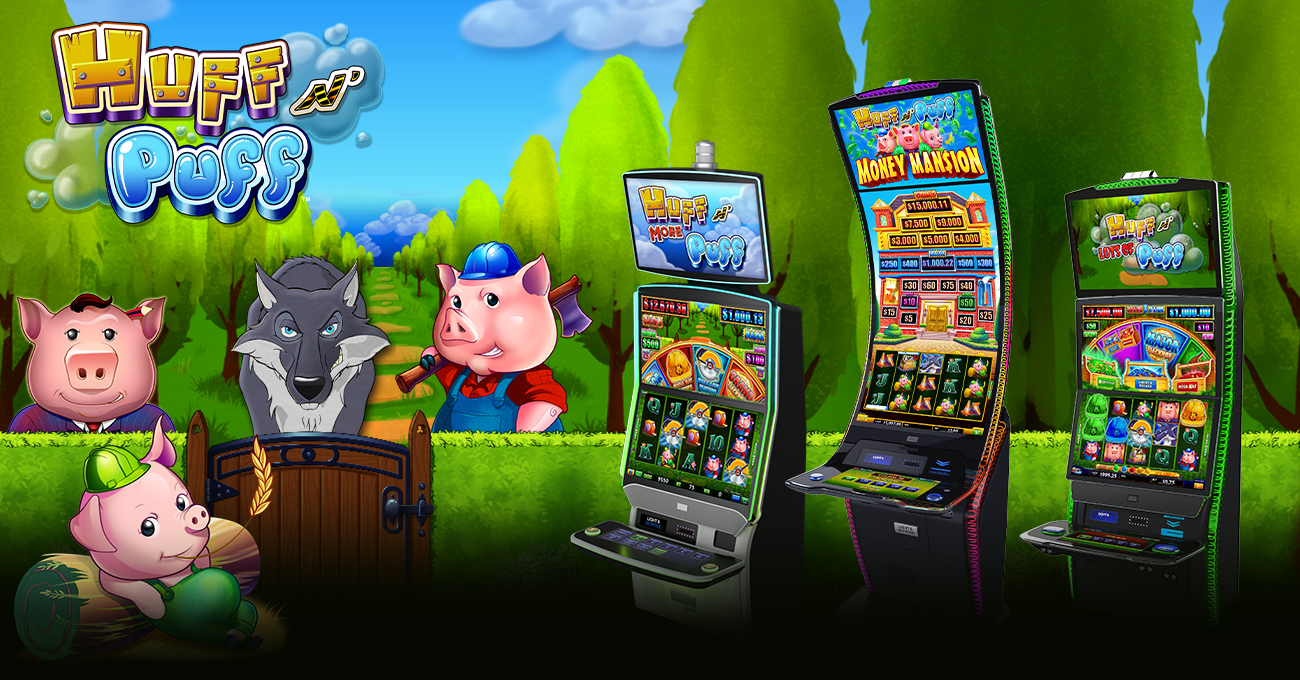
The first follow-up, Huff N More Puff, set the template. The introduction of a wheel mechanic was a conscious choice, built on something players already understood. The wheel delivered jackpot wedges and new features that amplified the core idea of creation and destruction without altering it.
As the franchise moved onto portrait cabinets, the same thinking applied. The expanded vertical screen allowed designers to add a second wheel, intensifying the experience while staying true to the underlying concept. Later titles experimented with expanding rows, lightbox-style features and bonus enhancements inspired by proven mechanics elsewhere in L&W’s portfolio.
Bettio explained that this philosophy guides every release: “With new, small additions we take the player through a journey, without changing its core.”
The result is a product line that evolves visibly, but predictably. For operators, that predictability reduces risk. For players, it reinforces trust – a valuable commodity in a competitive gaming business.
Innovation bounded by expectation
Bettio’s approach is shaped by a career that dates back to the mid-1990s. Over that time, technology has transformed almost every aspect of game design, but some fundamentals have remained constant.
“There are core base mechanics that never disappeared,” Bettio says. “Wild symbols, stacked symbols, scatter symbols. Every player expects them and they cannot really be removed from the design.”
That awareness underpins L&W’s broader product strategy. Innovation is encouraged but always anchored to elements players recognise and trust. The success of franchises such as Huff N Puff reflects an understanding that longevity is built on familiarity, not constant reinvention.
The challenge of franchising games is not innovation itself but managing it. Bettio is clear that creativity must operate within defined limits within the game’s core structure – its DNA.
Once that promise is fulfilled, designers can layer in change. Those additions may range from reel structure to feature mechanics, but they are always positioned as enhancements rather than corrections. This philosophy explains why Huff N Puff’s evolutions feel exploratory rather than disruptive.
That discipline also applies to tone and narrative. Bettio recalls a pitch session where a concept titled Huff N Puff We’ve Had Enuff was presented, featuring pigs that turn on the wolf. While Bettio looks back on the session with a smile, the game would have been turned on its head. The anecdote highlights the importance of coherence; even playful ideas must remain aligned with the franchise’s internal logic.
Responding to player behaviour and trends
Looking forward, franchise-led development at Light & Wonder is shaped by a combination of player insight, operator feedback and close attention to how behaviour evolves across channels. Bettio emphasises the importance of balance across the company’s business segments, rather than leaning too heavily in any one direction or strategy.
“We need to consider proven mechanics, N+1 – replication of proven mechanics with a tweak – evolution and mash-up of multiple game mechanics versus innovation and new-to-market concepts,” he explains.
That balanced approach is increasingly important as player behaviour continues to blur the lines between online and land-based play. As audiences move fluidly between channels, certain mechanics are beginning to cross over, although not always at the same pace. Bettio sees Buy-a-Bonus features which allow players to pay to access bonus rounds, games, and free spins directly – as an area to watch as expectations continue to evolve.
“With new, small additions we take the player through a journey, without changing its core.”
Other mechanics, such as variable-ways formats and cluster pays, are also being closely monitored as candidates for further evolution, particularly as cross-channel familiarity grows.
“Looking at the near future, I am curious to see how Buy-a-Bonus will evolve,” he says. “It is definitely popular in the online, while in land based, I see a more conservative approach.”
Franchise games’ strategic role
Within the wider product strategy, franchises continue to play an important strategic role. Huff N Puff remains a strong example of how a recognisable core can scale globally across land-based casinos, UK retail, online and social channels. Its success underlines the broader value of franchises as tools for brand recognition and player loyalty, especially in markets where presence is still developing.
“There are markets we are not present today, or where we have limited presence,” Bettio says. “Franchises could be good opportunities for brand recognition and player loyalty.”
Alongside Huff N Puff, L&W continues to invest in established families such as Ultimate Fire Link and Dancing Drums, while actively nurturing newer brands with long-term potential. That portfolio approach is supported by close collaboration between product management and game studios, ensuring creativity remains aligned with market realities.
Bettio says: “There is a healthy competition between the studios to design the best game and from product management to provide market feedback back to the designers.”
For Bettio, that structure ensures franchises remain commercially grounded without stifling innovation. “Franchises and brands will keep a relevant role into the future,” he says.
For the wider gaming business, the lesson is practical rather than theoretical. Sustainable success is rarely found in chasing every new mechanic or trend. Instead, it comes from understanding what players value, building on those foundations and having the discipline to protect them as games and franchises.